Recovery peptide research frequently brings together several disciplines. Cell biologists may examine migration and matrix production. Biochemists may study actin binding or receptor signaling. Analytical teams may investigate oxidation, disulfide formation or blend stability.
Because these projects often involve multiple peptides, ancillary materials and custom packaging, experimental design must separate biological effects from material-handling effects.
A combination may produce a different response from either peptide alone. Nevertheless, that observation does not automatically prove molecular synergy. Researchers first need controls that distinguish additivity, antagonism, assay interference and concentration error.
What Are Recovery Peptide Research Applications?
Recovery peptide applications are laboratory studies involving peptides selected for tissue, matrix, migration, cytoskeletal, oxidative or inflammatory research questions.
Representative systems may involve:
Tendon fibroblasts
Dermal fibroblasts
Endothelial cells
Cardiomyocyte models
Scratch-wound assays
Collagen-expression assays
Actin-polymerization studies
Receptor-signaling assays
Oxidative-stress models
Combination screens
Definition and Molecular Classification
BPC-157 is a synthetic 15-residue peptide. Thymosin beta-4 is a longer actin-binding peptide. GHK is a tripeptide that can coordinate copper. KPV is a three-residue sequence derived from the C-terminal region of alpha-melanocyte-stimulating hormone.
These materials differ structurally and mechanistically even when a supplier places them in the same recovery or peptide-blend category.
Critical Scientific Distinction: A recovery category describes an experimental theme. It does not mean that all listed peptides repair the same tissue, act through the same pathway or have equivalent levels of evidence.
BPC-157 has a reported molecular formula of C₆₂H₉₈N₁₆O₂₂ and a molecular weight near 1,419.5 g/mol. Cu-GHK is considerably smaller at approximately 403.92 g/mol in one defined molecular representation.
A blend containing equal milligrams of these materials would contain different molar amounts.
Additional structural factors include:
Free or amidated termini
Cysteine oxidation
Copper coordination
Acetylation
Counterion
Fragment length
Disulfide structure
Covalent label
Biological Roles in Research
Muscle Growth Peptides
Tendon-Fibroblast Migration
A 2011 study investigated BPC-157 in tendon explant and fibroblast systems and reported increased fibroblast outgrowth and migration under the study conditions.
A separate study found changes in growth-hormone-receptor expression and downstream JAK2 signaling in BPC-157-treated rat tendon fibroblasts. The findings remain limited to the experimental models used.
Actin and Cell Survival
Thymosin beta-4 interacts with actin-associated biology. An original study reported activation of integrin-linked kinase and examined cardiomyocyte migration, survival and repair responses in experimental models.
Matrix Regulation
Cu-GHK can support research into fibroblast and collagen-related pathways. Since copper itself can affect biological and analytical systems, investigators should include peptide-only and copper controls.
Combination Biology
A blend can produce:
Additive response
Greater-than-additive interaction
Antagonism
No interaction
Apparent interaction caused by assay interference
A factorial design provides more information than testing the blend alone.
Why Recovery Blends Are Studied
Researchers may use blends to ask whether two pathways influence the same endpoint.
For example:
Peptide A may affect fibroblast migration.
Peptide B may affect cytoskeletal organization.
The blend may change migration differently from either component.
However, a blend result has little mechanistic value unless A and B are also tested separately.
Major Research Mechanisms
Migration Pathway
Peptide exposure → signaling or cytoskeletal change → altered cell movement → migration measurement.
Matrix Pathway
Peptide or metal–peptide exposure → fibroblast response → collagen or matrix-related output.
Peptide A pathway + Peptide B pathway → shared or independent endpoint → factorial analysis.
Peptide Blend Research Design
A basic two-component design should contain four primary arms:
Vehicle
Peptide A
Peptide B
Peptide A + Peptide B
A stronger design also includes:
Positive control
Sequence control
Cytotoxicity measurement
Solvent-only control
Multiple concentrations
Independent experimental repeats
Research Comparison Table
Research Material
Representative Model
Possible Readout
Required Control
Main Interpretation Risk
BPC-157
Tendon fibroblast model
Migration or pathway expression
Vehicle and untreated cells
Preclinical findings overgeneralized
Thymosin beta-4-related material
Cytoskeletal or migration model
Actin or ILK-associated signal
Exact sequence control
Full-length peptide confused with fragment
Cu-GHK
Fibroblast matrix model
Collagen-related response
GHK and copper controls
Free copper drives the signal
Two-peptide blend
Factorial cell assay
Combination response
Both peptides tested separately
Additivity misreported as synergy
Ancillary vehicle
Same assay system
Background response
Vehicle-only arm
Solvent effect attributed to peptide
Practical Case: BPC-157 and an Actin-Related Peptide
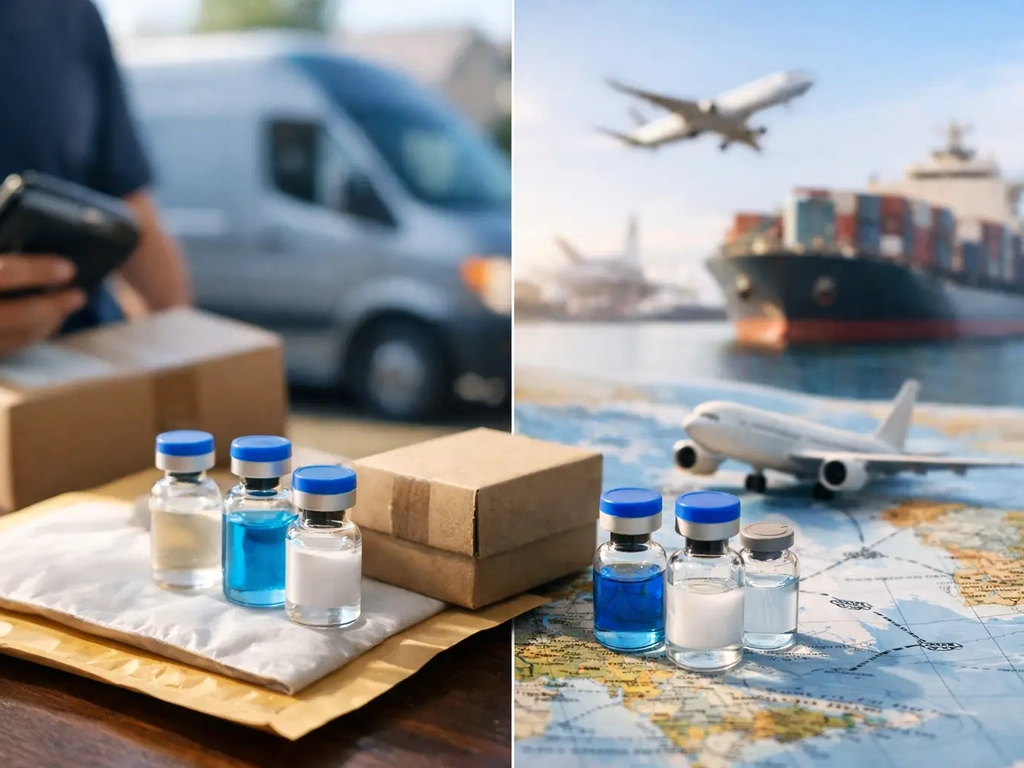
international peptide shipping
A laboratory wants to examine whether two recovery-category peptides affect fibroblast migration.
It designs the study as follows:
Vehicle
BPC-157 alone
Actin-related peptide alone
Combined treatment
Positive migration control
Cell-viability control
The laboratory measures:
Migration distance
Cell number
Cytotoxicity
Actin organization
Selected pathway proteins
A greater response in the combined arm does not automatically establish synergy. The team should compare the observed combination response with an explicit additive model and repeat the experiment across concentrations.
Ancillaries in Recovery Research
Reconstitution Vehicle
The vehicle can change peptide solubility, cell viability and receptor behavior. Every study requires a matched vehicle control.
Plasticware
Dilute or hydrophobic peptides may adsorb to tubes and plates. Low-binding materials can reduce loss, but researchers should verify recovery experimentally.
Filters
Filtration can remove particles, but it can also remove peptide through membrane adsorption.
Water and Buffers
pH and ionic strength influence charge, aggregation and metal coordination.
Custom Packaging and Experimental Reproducibility
Packaging affects research by preserving identity and handling history.
Useful label information includes:
Exact peptide or blend name
Sequence reference
Lot number
Nominal component quantities
Storage condition
Date of manufacture or retest
Research-use statement
Scannable inventory code
The carton or insert can provide reconstitution cautions without presenting human-use instructions.
Stability and Laboratory Handling
Potential risks include:
BPC-157 hydrolysis or oxidation
Thymosin-related oxidation
Copper exchange in Cu-GHK
Aggregation after blending
Surface adsorption
pH-driven precipitation
Repeated freeze–thaw cycles
Light exposure
The actual blend should undergo stability analysis in its final vial and intended solvent.
Maintaining Sample Integrity
Confirm all sequences and component ratios.
Equilibrate sealed vials before opening.
Prepare a matched vehicle.
Test solubility at small scale.
Avoid unnecessary filtration.
Make single-use aliquots.
Record thaw and handling history.
Retain material for later analytical confirmation.
Analytical and Quality Considerations
A research blend should receive:
HPLC or orthogonal separation
Component-specific MS
Ratio analysis
Content testing
Degradation evaluation
Solubility assessment
Vial-to-vial comparison
Packaging review
USP’s synthetic-peptide reference-standard work highlights the need for characterization, analytical testing, controlled handling and storage rather than reliance on one nominal purity result.
Frequently Asked Questions
What is recovery peptide research?
It is laboratory investigation of defined peptides in migration, matrix, cytoskeletal, inflammatory or related experimental systems. Recovery is an application theme rather than a chemical classification or clinical claim.
Is BPC-157 evidence mainly preclinical?
Most published mechanistic evidence comes from cell and animal models. These studies can support pathway research but do not establish broad clinical effectiveness, human safety or an administration protocol.
Is TB-500 the same as thymosin beta-4?
The label should not be assumed to identify the exact molecule. Researchers should request the complete sequence, terminal structure and molecular mass because commercial naming may not communicate whether the material is full length or a fragment.
How can researchers test peptide synergy?
Test each peptide alone and in combination across several concentrations. Then compare the observed combined effect with a predefined additive model. A larger raw signal by itself does not prove synergy.
Why is a vehicle control necessary?
Solvents, salts and buffers can affect cells, enzymes, fluorescence and peptide solubility. A matched vehicle arm helps separate peptide-dependent effects from preparation-related effects.
Can two peptides be mixed immediately before an assay?
They can, but the laboratory should first assess compatibility. Precipitation, adsorption, pH change or complex formation may alter the actual concentration delivered to the assay.
Does custom packaging improve scientific quality?
Packaging cannot correct poor synthesis, but it can preserve traceability, reduce mix-ups and protect the sample from moisture, light or damage. Those functions support reproducibility.
How should a blend be labeled?
The label should identify the blend and connect it to a detailed specification listing every component and nominal quantity. It should not present only a marketing name.
What is the best analytical method for a blend?
No universal method exists. Component-resolved LC-MS is often useful, while calibrated HPLC, content analysis or metal testing may also be required. The method must reflect the actual structures.
Why should laboratories retain unopened material?
A retained sample allows later investigation of degradation, content or batch identity. Without one, it may be impossible to distinguish an original manufacturing issue from changes caused during laboratory handling.
Conclusion
Recovery peptide and blend research requires controlled experimental design. Peptides should be evaluated individually before researchers interpret a combined response.
Ancillaries and packaging must also enter the scientific record because solvents, filters, containers and labels can influence concentration, stability and traceability.
For research materials: For Research Use Only. Not for human use.