


Peptide Purity Selection Guide
Selecting the right peptide purity starts with the research application, not with the highest available percentage.
For example, an early screening project may not require the same specification as a quantitative binding assay. Meanwhile, a modified peptide, fluorescent probe, or analytical reference may require tighter control over peptide-related impurities.
Therefore, this peptide purity selection guide helps researchers and buyers compare common purity levels before requesting custom peptide production.
At ALLGROWPEPTIDE, each project should be evaluated according to sequence complexity, research method, required quantity, modification, testing, and budget. Consequently, customers can avoid unnecessary purification costs while still selecting a suitable specification.
How to Select Peptide Purity
Peptide purity describes the proportion of the target peptide relative to detected peptide-related impurities under a defined analytical method.
However, one purity level does not suit every experiment.
First, researchers should consider whether the peptide will support screening, antibody-related work, biochemical analysis, quantitative measurement, or highly sensitive analytical research.
Next, they should evaluate whether closely related impurities could interfere with the intended method.
Finally, the selected purity should be confirmed together with the analytical package and required peptide quantity.
GenScript’s published selection guide associates purity above 70% with antibody generation or testing, above 85% with enzyme assays and biological-activity studies, above 95% with quantitative analysis, and above 98% with selected industrial requirements. These values provide a market reference rather than a universal scientific rule.
Recommended Peptide Purity by Research Application
| Research Application | Suggested Starting Purity | Selection Consideration |
|---|---|---|
| Initial Sequence Screening | Crude to ≥70% | Suitable when rapid sequence comparison matters more than quantitative accuracy |
| Antigen or Antibody-Related Research | ≥70%–80% | Review conjugation, immunogenic sequence and assay sensitivity |
| Routine Biochemical Assays | ≥85%–90% | Reduces interference from major peptide-related impurities |
| Binding or Quantitative Studies | ≥95% | Supports more consistent concentration and response comparisons |
| Sensitive Analytical Research | ≥98% | Consider net peptide content and additional impurity testing |
| Modified or Difficult Peptides | Technical review required | Modification and sequence complexity may limit achievable purity |
The table provides a practical starting point. Nevertheless, the final specification should follow the actual research protocol and technical feasibility.
What Does HPLC Peptide Purity Measure?
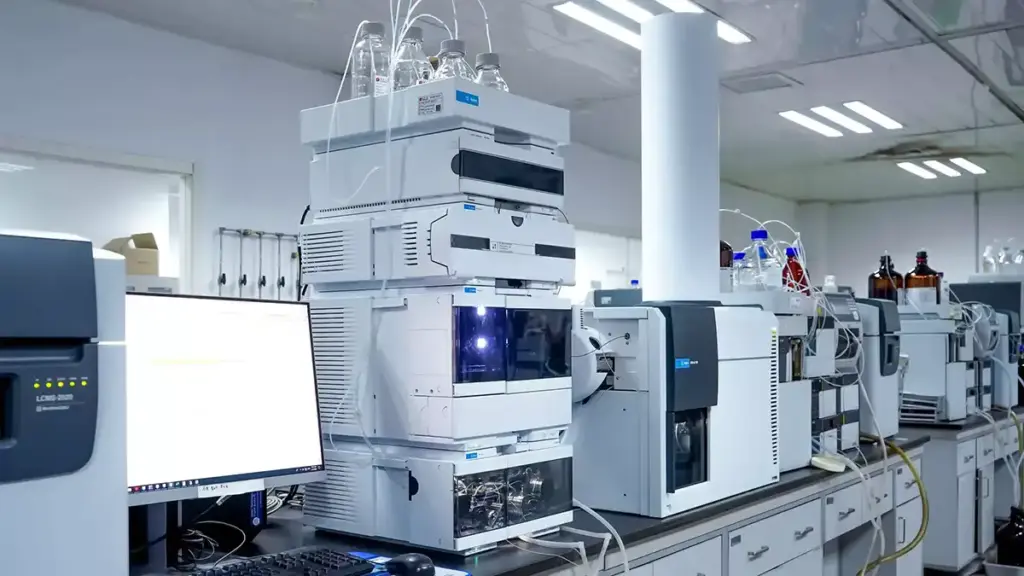
Reversed-phase HPLC separates the target peptide from detectable peptide-related components.
During analysis, the system measures the relative areas of the chromatographic peaks. Therefore, the reported percentage normally reflects the target peak compared with other detected peaks under the selected conditions.
However, HPLC purity does not automatically measure:
- net peptide content;
- residual water;
- counterions;
- inorganic salts;
- residual solvents;
- vial quantity;
- sterility;
- endotoxin level.
Bachem explains that peptide purity usually refers to the target peptide relative to impurities that absorb at the peptide-bond wavelength. It also distinguishes chromatographic purity from net peptide content
Peptide Purity, Identity and Content
```html
```
| Quality Attribute | What It Evaluates | Typical Method |
|---|---|---|
| Peptide Purity | Target peptide relative to detected peptide-related impurities | RP-HPLC |
| Molecular Identity | Observed molecular mass compared with the expected structure | Mass spectrometry |
| Net Peptide Content | Actual peptide portion after accounting for water, salts and counterions | AAA, elemental analysis or another validated method |
| Quantity | Amount supplied in the vial or container | Gravimetric or project-specific method |
| Counterion Content | Associated TFA, acetate or another counterion | Ion analysis or project-specific testing |
Factors That Affect the Required Purity
1. Research method
Quantitative assays usually require tighter specifications than preliminary sequence screening.
2. Sequence complexity
Long, hydrophobic, aggregation-prone, or oxidation-sensitive sequences may generate closely related impurities.
Modification type
Fluorescent dyes, biotin, lipids, linkers, cyclization, and non-standard residues can alter purification behavior.
Concentration accuracy
When researchers calculate concentration from total vial weight alone, water and counterions may affect the result. Therefore, net peptide content may become important.
Interference risk
A low-level impurity may matter greatly when it binds the same target, absorbs at the same wavelength, or affects the assay response.
Documents to Request Before Ordering
| Document | Recommended Information |
|---|---|
| Certificate of Analysis | Product name, sequence, lot number, specification and results |
| HPLC Report | Chromatogram, method summary, retention time and peak-area result |
| Mass Report | Theoretical and observed molecular-mass information |
| Quantity Statement | Amount supplied and measurement basis |
| Additional Testing | Content, water, counterion or endotoxin data when required |
Frequently Asked Questions
Is higher peptide purity always better?
Higher purity may reduce interference. However, it also requires more purification work and may increase cost or reduce recovered quantity. Therefore, choose purity according to the research method.
Does 95% HPLC purity mean the vial contains 95% peptide by weight?
Not necessarily. HPLC purity and net peptide content measure different attributes.
Is mass spectrometry the same as purity testing?
No. Mass spectrometry supports molecular identity, while HPLC commonly evaluates chromatographic purity.
Can every peptide reach 98% purity?
No. Sequence length, aggregation, hydrophobicity, modifications, and closely related impurities may limit achievable purity.
Which purity should I request for quantitative research?
A starting specification of ≥95% is common. Nevertheless, the analytical method, content requirement, and interference risk should also be reviewed.
Choose a Purity Level That Matches Your Research
Submit your sequence, research application, required quantity, modification, and testing requirements.
Our team can then review the project and prepare a specification-based quotation.