


Peptide Purity Selection Guide
Selecting the right peptide purity starts with the research application, not with the highest available percentage.
For example, an early screening project may not require the same specification as a quantitative binding assay. Meanwhile, a modified peptide, fluorescent probe, or analytical reference may require tighter control over peptide-related impurities.
Therefore, this peptide purity selection guide helps researchers and B2B buyers compare common purity levels before requesting custom peptide production.
At ALLGROWPEPTIDE, each project should be evaluated according to sequence complexity, research method, required quantity, modification, testing, and budget. Consequently, customers can avoid unnecessary purification costs while still selecting a suitable specification.
Why Peptide Solubility Matters
Poor solubility can produce inaccurate concentration calculations, visible precipitation, inconsistent assay responses, and unnecessary sample loss.
Moreover, a peptide may appear clear at first and then aggregate after dilution, pH adjustment, cooling, or extended storage.
Therefore, researchers should evaluate both initial dissolution and stability under the final assay conditions.
GenScript describes proper solubilization as an important factor in successful peptide assays. Its commercial solubility-testing page reports that most tested peptides dissolve in at least one common laboratory solvent, although its published success percentages represent GenScript’s service data rather than a universal guarantee.
Review the Sequence Before Selecting a Solvent
The amino-acid sequence provides the first clues about likely solubility.
First, count acidic and basic residues. Next, examine hydrophobic amino acids and repeated non-polar regions. Finally, review terminal groups, labels, lipids, and other modifications.
Bachem recommends evaluating polarity, acidic residues, basic residues, neutral residues, and terminal functionality before selecting a solvent. It also notes that no single dissolution protocol can cover every peptide.
| Sequence Feature | Possible Behaviour | Initial Consideration |
|---|---|---|
| Several Acidic Residues | May carry a negative charge near neutral pH | Evaluate a mildly basic aqueous condition |
| Several Basic Residues | May carry a positive charge near neutral pH | Evaluate a mildly acidic aqueous condition |
| Many Hydrophobic Residues | May show limited aqueous solubility or aggregation | Test a controlled co-solvent strategy |
| Cys, Met or Trp | May show greater oxidation sensitivity | Limit unnecessary air and light exposure |
| Fluorescent or Lipid Modification | May increase hydrophobicity | Review the modified molecule rather than the base sequence alone |
| Multiple Charged Residues | May absorb moisture in lyophilized form | Keep the vial tightly closed and dry |
A Step-by-Step Peptide Solubility Strategy
Step 1: Confirm the final research conditions
Identify the desired concentration, buffer, pH, ionic strength, and assay compatibility before dissolving the entire sample.
Step 2: Test a small portion first
Use a small test quantity whenever possible. Consequently, the remaining material stays available if the first solvent system fails.
Step 3: Start with a compatible aqueous system
Water or the final experimental buffer may provide a suitable starting point for many peptides.
However, the sequence and required concentration should guide the decision.
Step 4: Adjust pH carefully
A basic peptide may dissolve more readily under mildly acidic conditions. Conversely, an acidic peptide may respond better to a mildly basic condition.
Nevertheless, extreme pH may damage sensitive residues or conflict with the final assay.
Step 5: Consider a compatible co-solvent
Hydrophobic peptides may require a limited amount of an organic co-solvent.
However, researchers should confirm that the final co-solvent concentration remains compatible with the experimental system.
Step 6: Dilute gradually
After preparing a concentrated stock, add the final buffer gradually while monitoring clarity.
Consequently, sudden precipitation may be reduced.
Solubility Planning Table
| Planning Question | Why It Matters |
|---|---|
| What final concentration is required? | A peptide may dissolve at a low concentration but precipitate at a higher one |
| Which buffer will the assay use? | Solubility may change after transfer into the final buffer |
| Does the sequence contain hydrophobic regions? | Hydrophobic sequences may aggregate in aqueous systems |
| Does the peptide carry a label or lipid? | Modifications may change charge and hydrophobicity |
| Will the stock be stored? | Solution stability is usually shorter than lyophilized stability |
| Can the material be divided into aliquots? | Aliquoting reduces repeated opening and freeze-thaw cycles |
Handling Lyophilized Peptides
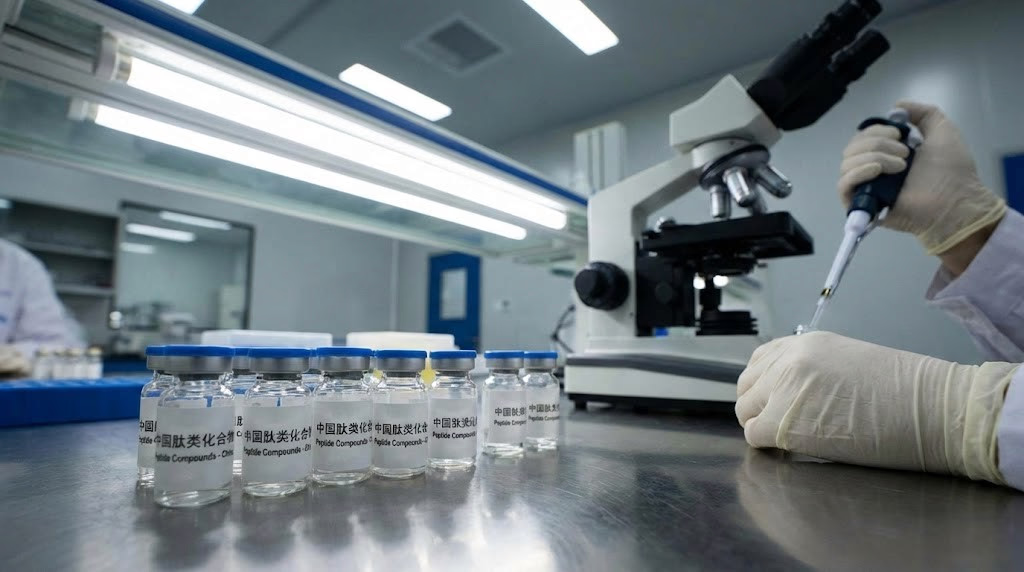
Allow a cold peptide vial to approach room temperature before opening it.
This step reduces the risk of moisture condensing inside the vial. Next, open the container only for the time needed to remove the required amount. Finally, reseal it tightly and return the remaining material to the recommended storage condition.
Moreover, hygroscopic peptides may absorb atmospheric moisture. Therefore, repeated opening can change the apparent vial weight and reduce stability.
Bachem recommends allowing lyophilized peptide containers to reach ambient temperature before opening, especially because many peptides absorb moisture. GenScript publishes similar guidance and advises researchers to reseal the vial quickly
Storage and Aliquoting
Product-specific documentation should always take priority over a general website guide.
Nevertheless, established peptide suppliers commonly recommend keeping lyophilized peptides cold, dry, tightly sealed, and protected from strong light.
Bachem recommends storage below −15°C for longer-term storage of many lyophilized peptides, while GenScript commonly recommends −20°C. Both sources also advise limiting freeze-thaw cycles and dividing material into working aliquots
| Handling Area | Recommended General Practice |
|---|---|
| Before Opening | Allow the sealed vial to approach room temperature |
| Moisture Control | Work quickly and keep the vial tightly capped |
| Light Protection | Protect sensitive or fluorescent peptides from strong light |
| Working Portions | Prepare project-specific aliquots when repeated use is expected |
| Freeze-Thaw Exposure | Avoid repeated cycles whenever possible |
| Solution Storage | Follow sequence-specific data and avoid unnecessary long-term storage |
Troubleshooting Poor Peptide Solubility
The peptide does not dissolve in water
Review the sequence charge and hydrophobicity. Then test a small amount under a more suitable pH or compatible co-solvent condition.
The solution becomes cloudy after dilution
The stock solvent may support dissolution, while the final buffer does not. Therefore, reduce the dilution rate and review final ionic strength, pH, and concentration.
The peptide dissolves but later forms particles
Aggregation may develop over time. Consequently, prepare fresh working solutions and avoid unnecessary storage.
The measured concentration appears inconsistent
Check whether the calculation used total powder weight instead of net peptide content. In addition, review moisture absorption and counterion contribution.
A modified peptide behaves differently from the unmodified sequence
The label, lipid, linker, or conjugate may change hydrophobicity and charge. Therefore, evaluate the final modified molecule independently.
Frequently Asked Questions
Is water always the best solvent for peptides?
No. Sequence charge, hydrophobicity, modification, pH, and concentration influence the best solvent.
Can I use DMSO for every hydrophobic peptide?
No. DMSO may support some hydrophobic peptides, but the final research system must tolerate the remaining DMSO concentration.
Why should I test a small amount first?
A small-scale test reduces sample loss and allows researchers to compare solvent conditions.
Should peptide solutions be stored for long periods?
Generally, lyophilized material offers better storage stability than peptide solutions. However, always follow product-specific data.
Why should freeze-thaw cycles be avoided?
Repeated freezing and thawing may increase degradation, aggregation, oxidation, or concentration variability.
Need Help Planning Peptide Solubility?
Submit the sequence, modification, required concentration, buffer, and research application.
Our technical team can review the available information before custom production or packaging is confirmed.