


Custom Peptide Production for Research and Buyer Projects
Custom peptide production gives laboratories and buyers greater control over sequence, purity, quantity, modifications, testing, and packaging.
At ALLGROWPEPTIDE, our team reviews each project before production begins. First, we examine the sequence and technical requirements. Next, we confirm the production scale, target purity, modifications, analytical methods, and final packaging.
Moreover, we support research laboratories, biotechnology companies, academic institutions, distributors, and qualified global buyers.
Therefore, every customer receives a project-specific plan rather than a fixed production package.
Custom Peptide Production Designed Around Your Project
A peptide project depends on more than its amino-acid sequence.
For example, sequence length, hydrophobicity, charge distribution, aggregation risk, terminal structure, and unusual residues can affect production efficiency.
Therefore, our technical team evaluates each project before preparing a quotation.
During this review, we identify potential synthesis and purification challenges. We also examine the requested purity, quantity, modifications, testing, and packaging.
As a result, the production strategy can match the peptide’s structure and intended research application more closely.
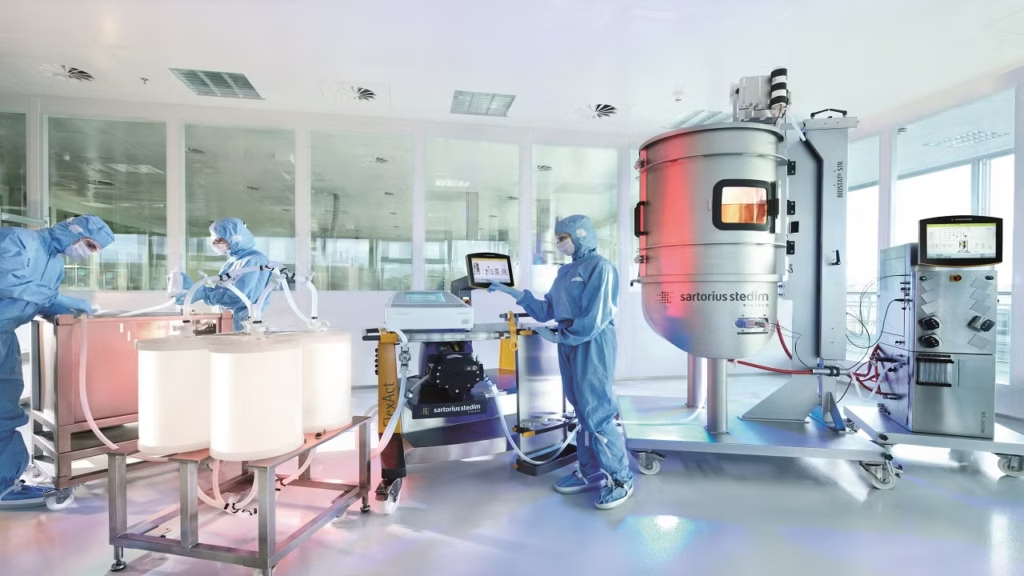
Most projects use solid-phase peptide synthesis because the method supports controlled amino-acid assembly. However, selected sequences may require an adjusted or hybrid strategy.
Consequently, we choose the final approach only after reviewing the complete project specification.
How Custom Peptide Production Works
1. Submit the Project Requirements
First, send the complete peptide sequence.
Also include the required quantity, purity, terminal structure, modifications, testing, packaging, and destination.
2. Review Technical Feasibility
Next, our team evaluates sequence length, hydrophobic regions, charge distribution, difficult residues, and aggregation risk.
Furthermore, we review cyclization, disulfide bonds, labels, linkers, and other special requirements.
3. Confirm the Production Specification
We then confirm the sequence, scale, purity, modification, analytical package, packaging, and expected schedule.
Consequently, both parties can follow one approved specification.
4. Start Peptide Production
Our production team selects a suitable synthesis strategy.
In most cases, amino acids are assembled in a defined order through solid-phase peptide synthesis.
However, difficult sequences may require additional optimization.
5. Purify and Test the Peptide
After synthesis, the target peptide is separated from truncated sequences and related impurities.
Next, HPLC and mass spectrometry are used according to the confirmed analytical plan.
6. Package and Deliver the Batch
Finally, the product is prepared in the selected format.
Our team checks the vial, label, quantity, batch information, documents, and outer packaging before dispatch.
Custom Peptide Production Capabilities
Our custom peptide production service can support catalog development, laboratory projects, repeat purchasing, and private-label supply.
Moreover, each specification can be adjusted according to the buyer’s requirements.
| Production Area | Available Support |
|---|---|
| Sequence Review | Length, charge, hydrophobicity and difficult residues |
| Production Quantity | Research and commercial quantities after technical review |
| Purity Options | Crude, ≥80%, ≥90%, ≥95% and ≥98% |
| Product Format | Lyophilized powder or another confirmed format |
| Terminal Options | Free termini, acetylation and amidation |
| Special Modifications | Labels, linkers, cyclization and conjugation |
| Analytical Testing | HPLC, mass spectrometry and agreed additional tests |
| Documentation | COA and available batch-specific analytical records |
| Packaging | Standard vials, aliquots or custom packaging |
Why Choose ALLGROWPEPTIDE?
Project-Specific Review
Our team reviews the sequence and production requirements before issuing a final plan.
Therefore, technical challenges can be discussed early.
Flexible Purity Options
Customers can select purity according to the intended research application.
Consequently, unnecessary purification costs may be avoided.
Modification Support
We evaluate terminal groups, labels, linkers, cyclization, lipidation, and other specialized requirements.
Analytical Transparency
Available HPLC, MS, and COA records support batch-level evaluation.
However, customers should confirm the exact testing package before ordering.
Custom Packaging
Vials, labels, aliquots, cartons, and private-label packaging can be coordinated.
Global Buyer Service
Our team reviews product specifications, documentation, packaging, and destination requirements before delivery.
Recommended Peptide Purity Levels
The highest purity does not automatically provide the best value for every project.
Instead, researchers should select purity according to the intended application.
For example, preliminary screening may accept lower-purity material. However, quantitative assays and sensitive analytical studies often require higher purity.
Therefore, the following table should be presented as a selection guide rather than a universal rule.
| Research Application | Suggested Purity |
|---|---|
| Initial screening or sequence evaluation | Crude to ≥70% |
| General biochemical research | ≥80% |
| Antibody-related and routine assays | ≥85%–90% |
| Quantitative biological studies | ≥95% |
| Sensitive analytical applications | ≥98% |
| Specialized production projects | Technical review required |
Frequently Asked Questions
Are analytical documents available?
Available documents depend on the confirmed project. Therefore, request HPLC, MS, COA, or other reports before approving the quotation.
Can repeat batches be ordered?
Yes. However, every new production batch should receive its own identification, testing, and documentation.
Can you provide custom packaging?
Custom labels, vials, aliquots, cartons, inserts, and selected private-label options can be reviewed.
Are these products intended for human use?
No. Products and services on this page are intended strictly for qualified laboratory research.
Can every peptide sequence be produced?
Not always. Long, hydrophobic, aggregation-prone, or heavily modified sequences may create technical challenges. Therefore, our team reviews feasibility first.
What purity should I select?
Choose purity according to the research method. Preliminary studies may accept lower purity, while quantitative studies may require ≥98%.
Does HPLC confirm peptide identity?
HPLC mainly evaluates chromatographic purity. Meanwhile, mass spectrometry supports molecular-mass and identity evaluation.
Can I request peptide modifications?
Yes. Submit the modification type, attachment position, linker requirement, quantity, and target purity.
Start Your Custom Peptide Production Project
Turn your peptide sequence into a clearly defined research product.
First, submit the sequence, quantity, purity, modifications, testing, and packaging requirements.
Next, our team will review the technical details and prepare a project-specific proposal.
Moreover, custom packaging and international Buyer delivery can be discussed within the same project.