


首页 » Custom Peptide Packaging
Custom Peptide Packaging Designed Around Your Brand
Custom peptide packaging is provided for research-product brands, laboratories, distributors, sourcing companies, and qualified buyers.
Vials, closures, labels, boxes, inserts, batch coding, and export packaging may be coordinated within one project. Therefore, a consistent presentation can be created across the complete product range.
Moreover, each configuration is reviewed according to vial dimensions, product format, storage conditions, order quantity, branding requirements, and destination.
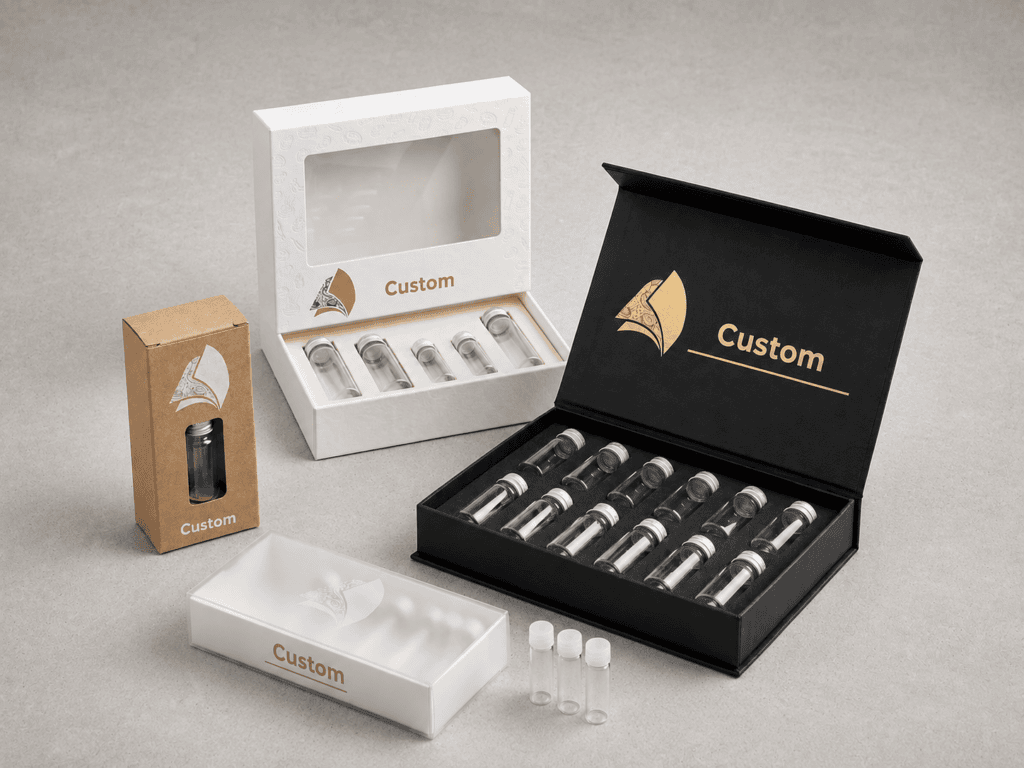
Custom Packaging Should Protect More Than Your Brand Image
Peptide packaging is often treated as a visual design project. However, product protection, component compatibility, batch identification, label readability, and transportation conditions must also be considered.
Therefore, the packaging system should be developed around the physical product rather than around artwork alone.
A complete packaging system may include the vial, stopper, seal, label, insert, carton, tamper feature, and shipping box. USP describes a container-closure system as the combined components that contain and protect a product. Consequently, the complete system should be considered rather than each component being evaluated separately.
Meanwhile, precision-fit inserts are frequently promoted by peptide packaging suppliers because vial movement can be reduced during storage and transportation. Current suppliers commonly design boxes for 2mL, 3mL, 5mL, and 10mL vial formats.
Complete Custom Peptide Packaging Services
Custom Glass Vials
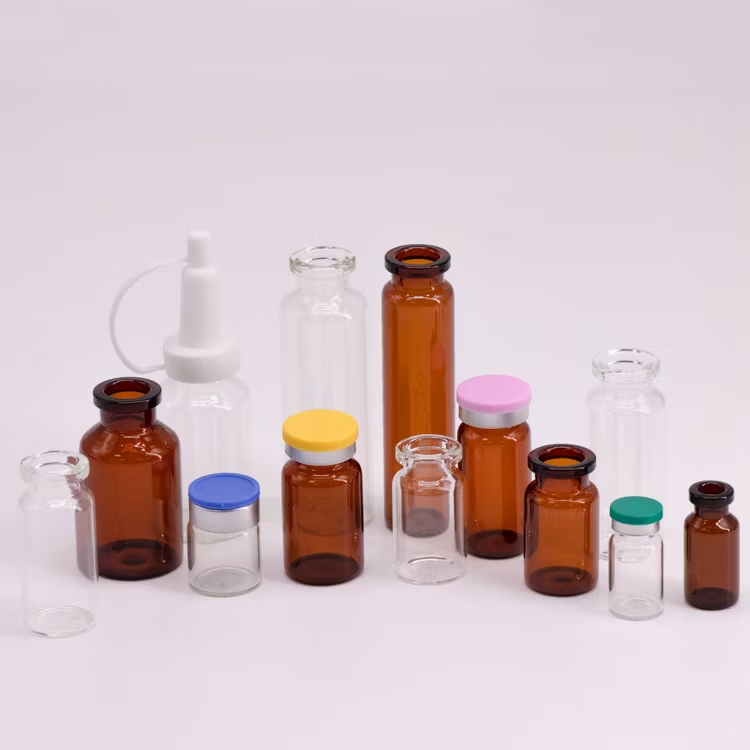
Clear or amber glass vials may be selected according to the product presentation and technical requirements.
Type I borosilicate glass is widely used for pharmaceutical vial applications because high chemical resistance is provided. SCHOTT Pharma currently publishes Type I borosilicate vial formats ranging from 2R to 100R. Nevertheless, your available sizes should be confirmed according to actual inventory and supplier capacity.
Stoppers, Seals and Flip-Off Caps
Compatible elastomeric stoppers, aluminum seals, and flip-off caps may be coordinated with the selected vial.
However, appearance should not be the only consideration. Proper dimensional fit is especially important for lyophilized products because closure integrity and moisture resistance may be affected by the vial-and-stopper combination.
Custom Peptide Vial Labels
Vial labels may be printed with product names, quantities, brand information, batch fields, storage wording, barcodes, QR codes, and research-use statements.
Moreover, paper, synthetic film, metallic, holographic, matte, gloss, waterproof, and cold-resistant materials may be evaluated according to project requirements.
Custom Peptide Boxes
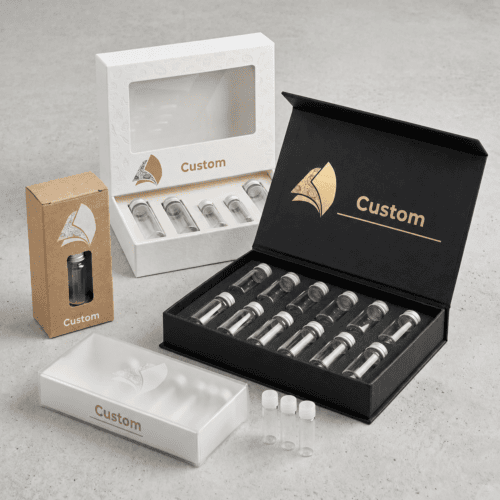
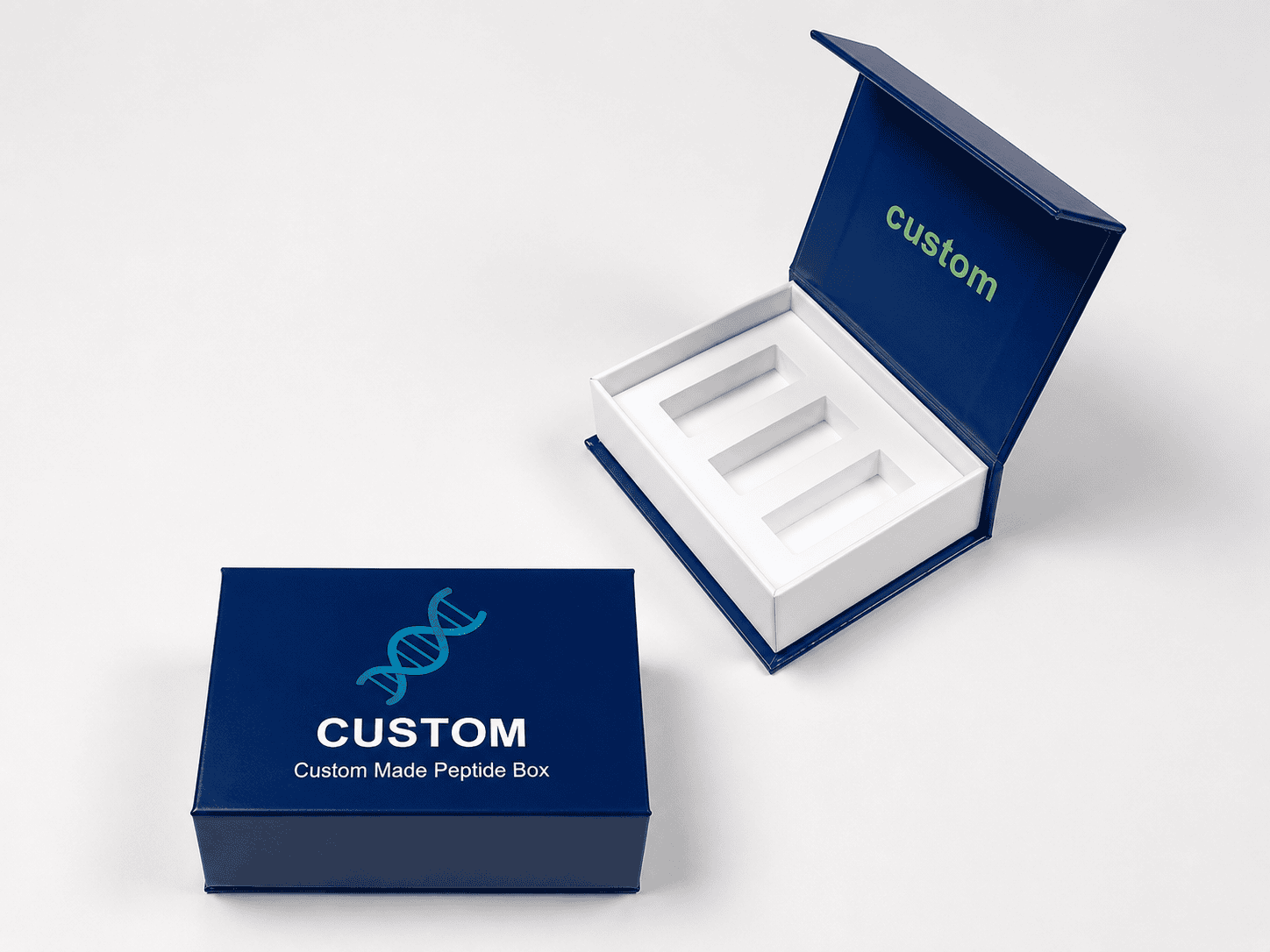
Single-vial boxes, multi-vial boxes, kit boxes, window boxes, folding cartons, rigid boxes, and shipping cartons may be developed.
Therefore, different packaging levels can be created for standard catalog products, premium product ranges, wholesale kits, and export orders.
Precision-Fit Inserts
Paperboard, foam, EVA, molded pulp, or plastic inserts may be considered according to the product format.
The vial diameter, vial height, cap diameter, box dimensions, and required clearance should be measured before the insert is produced.
Tamper-Evident Packaging
Tamper seals, shrink sleeves, security labels, holographic elements, scratch codes, and tear-strip structures may be added.
Current peptide packaging suppliers frequently promote tamper-evident seals, shrink sleeves, labels, secondary boxes, and package inserts as part of complete packaging programs.
Export-Ready Outer Packaging
Finally, inner boxes may be placed inside reinforced master cartons with cushioning and protective separation.
Shipping labels, packing lists, batch references, and carton quantities may then be coordinated for international B2B delivery.
Available Packaging Components
| Packaging Component | Customizable Options | Main Purpose |
|---|---|---|
| Glass Vials | Size, color, neck finish and vial style | Primary product containment |
| Stoppers | Size, material and lyophilization design | Closure and moisture protection |
| Aluminum Seals | Color, size and flip-off configuration | Secures the vial closure |
| Vial Labels | Material, finish, size, artwork and variable data | Product identification and branding |
| Individual Boxes | Dimensions, printing, board and finishing | Secondary protection and presentation |
| Protective Inserts | Paperboard, foam, EVA, pulp or plastic | Reduces product movement |
| Security Features | Tamper seals, QR codes, holograms and scratch codes | Supports product verification |
| Shipping Cartons | Size, strength, inserts and shipping labels | Protects products during transportation |
Packaging Options for Different Vial Formats
The following dimensions represent commonly marketed peptide packaging formats rather than guaranteed company specifications. Current peptide box and label suppliers frequently support 2mL, 3mL, 5mL, and 10mL vials.
| Vial Format | Typical Packaging Use | Recommended Box Type |
|---|---|---|
| 2mL | Compact lyophilized peptide presentation | Single-vial or multi-vial folding box |
| 3mL | Common research peptide packaging | Single-vial box with fitted insert |
| 5mL | Larger vial or specialized presentation | Reinforced folding carton |
| 10mL | Laboratory or ancillary product packaging | Custom-height box with insert |
| Multi-Vial Kit | Product sets and wholesale collections | Rigid or folding kit box |
| Custom Format | Specialized vial or accessory combination | Project-specific structural design |
Primary, Secondary and Shipping Packaging
Primary Packaging
Primary packaging remains in direct contact with the product.
Therefore, the vial, stopper, and seal are normally included within this level.
Component suitability, material compatibility, dimensions, closure fit, and product-specific requirements should be reviewed before the configuration is approved.
Secondary Packaging
Secondary packaging surrounds and protects the primary container.
Accordingly, vial labels, individual cartons, inserts, instruction cards, tamper seals, and branded sleeves may be included.
Furthermore, additional space may be provided for batch data, storage wording, barcodes, and research-use statements.
Tertiary Packaging
Tertiary packaging is used for handling, consolidation, storage, and shipping.
Consequently, inner cartons, dividers, cushioning materials, master cartons, shipping labels, and pallet labels may be introduced.
Glass Vial and Closure Selection
Type I borosilicate glass is frequently selected for sensitive pharmaceutical formulations because chemical resistance and dimensional consistency are provided. Clear and amber options are also commercially available. For example, DWK markets clear and amber serum vials, including 2mL and 5mL formats intended for lyophilization-related and pharmaceutical packaging applications.
However, a glass specification should not be selected from appearance alone.
The following items should also be reviewed:
- nominal vial capacity;
- fill quantity;
- neck and finish dimensions;
- stopper compatibility;
- seal diameter;
- lyophilization requirements;
- light sensitivity;
- product-contact requirements;
- washing or sterilization status;
- storage and transportation conditions.
Vial, Stopper and Seal Reference Options
| Component | Reference Options | Confirmation Required |
|---|---|---|
| Vial Material | Type I borosilicate glass | Material certificate and product suitability |
| Vial Color | Clear or amber | Light-protection requirement |
| Common Capacity | 2mL, 3mL, 5mL or 10mL | Actual vial dimensions |
| Stopper | Standard or lyophilization stopper | Neck size and material compatibility |
| Seal | Aluminum or flip-off seal | Seal diameter and closure fit |
| Cap Color | Standard or customized color | Availability and order quantity |
| Processing Status | Bulk, cleaned or ready-to-use options | Supplier documentation |
Custom Peptide Vial Labels
Labels should be designed for identification before decoration is considered.
Therefore, product names, quantities, batch information, and storage statements should remain clear after the label has been applied.
Moreover, the label material should be selected according to the storage environment. A paper label may be suitable for standard dry storage. However, synthetic film or specialized adhesive may be considered when moisture, refrigeration, condensation, oil, or repeated handling is expected.
Current custom-label suppliers commonly promote waterproof labels for 3mL, 5mL, and 10mL vial formats. A 40mm × 20mm label is also marketed for some standard 3mL and 5mL vials. Nevertheless, label dimensions must be tested against the actual vial before printing.
| Label Field | Recommended Content |
|---|---|
| Brand Name | Approved company or product brand |
| Product Name | Full and clearly readable product identity |
| Net Quantity | Quantity matched to the packaging record |
| Batch or Lot Number | Controlled batch-specific identifier |
| Storage Statement | Product-specific storage instruction |
| Research-Use Statement | Research use only, where applicable |
| QR Code | Optional link to batch or product information |
| Manufacturer Details | Included according to project requirements |
Batch Coding and Packaging Traceability
A batch code should not be treated as decorative text.
Instead, the code should be linked with the corresponding product, manufacturing or packing records, testing documents, and customer order.
GS1’s Global Traceability Standard supports systems in which products can be identified at product, batch, lot, or serialized levels. Therefore, a batch number may be used to distinguish one defined production group from another.
Moreover, barcodes and QR codes may be used to improve digital access. However, the code only remains useful when reliable records are maintained behind it.
| Packaging Identifier | Record Connection |
|---|---|
| Product Code | Product name and approved specification |
| Batch Number | Production, testing and release records |
| Packaging Code | Label, carton and component version |
| Order Number | Buyer, quantity and invoice information |
| Shipment Reference | Packing list, carrier and tracking data |
| QR or Barcode | Optional digital product or batch record |
Custom Peptide Box Materials
Different board structures may be selected according to product weight, protection requirements, presentation, and budget.
For example, one current peptide kit-box supplier publishes 300–400gsm kraft board, 14pt and 18pt SBS board, E-flute and B-flute corrugated board, and 1.5–2.5mm rigid chipboard. These figures can be used as market references but should not be listed as guaranteed company capabilities without supplier confirmation.
| Material | Reference Range | Suggested Application |
|---|---|---|
| White Cardstock | 14pt–18pt reference range | Printed individual vial boxes |
| Kraft Paperboard | 300–400gsm reference range | Natural or recyclable packaging concepts |
| E-Flute Corrugated | Project-specific thickness | Protective retail and shipping boxes |
| B-Flute Corrugated | Project-specific thickness | Larger or heavier shipping packages |
| Rigid Chipboard | 1.5–2.5mm reference range | Premium multi-vial kit boxes |
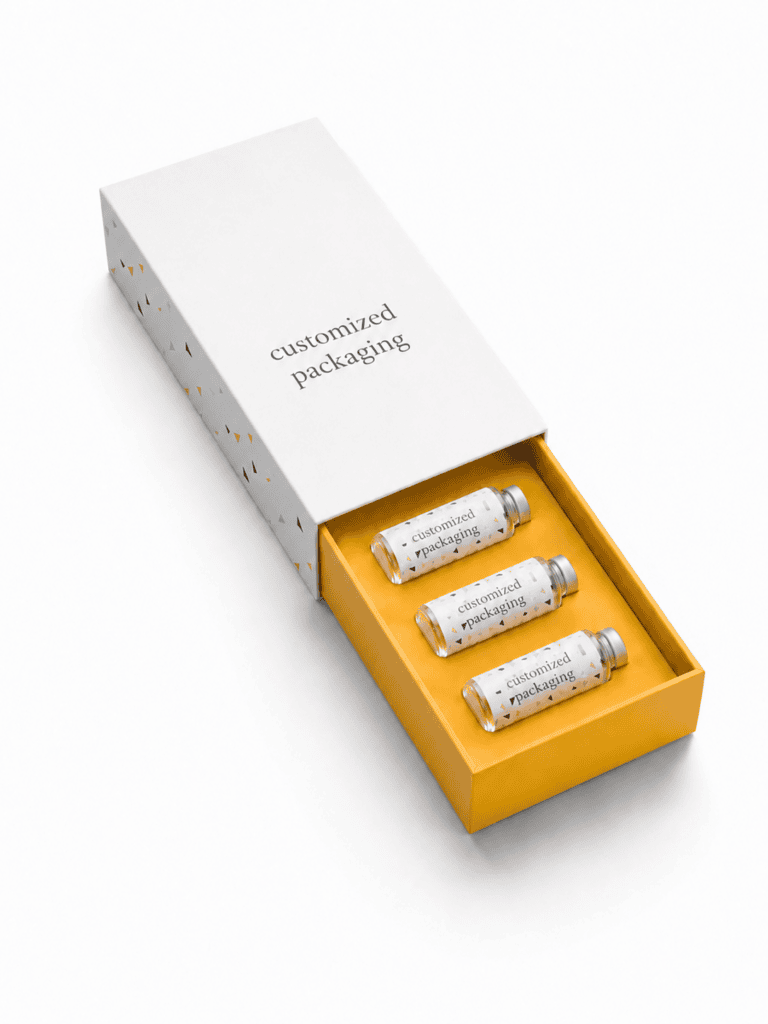
Printing and Finishing Options
A clean clinical appearance may be created through restrained colors and clear typography. Alternatively, premium effects may be introduced for selected product ranges.
However, finishing methods should not reduce the readability of variable batch information.
Available Finishing Options
- CMYK full-color printing;
- Pantone color matching;
- matte lamination;
- gloss lamination;
- soft-touch coating;
- spot UV;
- embossing or debossing;
- gold or silver foil;
- holographic foil;
- transparent windows;
- metallic label materials;
- tamper-evident seals.
Current custom peptide-box suppliers commonly promote matte lamination, soft-touch finishes, foil stamping, spot UV, embossing, window cutouts, and precision-fit inserts.
Custom Packaging for Single Vials and Multi-Vial Kits
Single-Vial Packaging
A folding carton can be developed for one glass vial.
A fitted insert may then be added so that the vial is held in the intended position.
Moreover, a carton window may be introduced when product visibility is required.
Multi-Vial Packaging
Multi-vial packaging may be developed for 5-unit, 10-unit, or project-specific product sets.
However, the number of positions should be confirmed according to vial dimensions and carton strength.
Peptide and Ancillary Kits
Separate positions may be created for vials and permitted laboratory accessories.
Accordingly, inserts may be divided according to each component’s size and shape.
Wholesale and Distributor Packaging
Several SKUs may be coordinated through consistent label templates and color-coded packaging.
Therefore, product identification can be improved without requiring a completely separate visual system for each item.
How Is a Custom Peptide Packaging Project Managed?
01. Project Requirements Are Submitted
First, the vial size, product quantity, box type, label requirements, branding files, order volume, and destination are provided.
02. Components Are Reviewed
Next, vial dimensions, closure type, insert structure, label size, carton material, and shipping configuration are evaluated.
03. A Structural Design Is Prepared
A dieline is then created according to the confirmed component dimensions.
Moreover, the insert position and product clearance are considered during this stage.
04. Artwork Is Applied
The approved brand design, product information, batch fields, storage wording, and necessary statements are added.
05. A Digital Proof Is Reviewed
Before production is started, text, colors, dimensions, cut lines, folds, and variable-data positions are checked.
06. A Physical Sample May Be Produced
When required, a packaging sample may be prepared for fit, appearance, and assembly evaluation.
07. Production Is Completed
After approval has been received, printing, cutting, finishing, gluing, and assembly are performed.
08. Final Inspection Is Conducted
Finally, box dimensions, print quality, labels, inserts, quantities, and export cartons are reviewed before dispatch.
Packaging Quality-Control Checklist
| Inspection Item | What Is Checked |
|---|---|
| Vial Fit | Vial dimensions match the selected insert |
| Closure Fit | Stopper, seal and vial dimensions are compatible |
| Label Position | Labels are aligned and readable |
| Artwork Accuracy | Names, quantities and statements match approved files |
| Batch Fields | Variable-data areas are correctly positioned |
| Insert Security | Vials are held without excessive movement |
| Carton Assembly | Folds, glue points and closures are inspected |
| Shipping Protection | Inner and outer packaging support the order quantity |
Why Choose Custom Peptide Packaging?
Coordinated Component Sourcing
Vials, labels, boxes, inserts, and outer packaging may be coordinated through one confirmed specification.
Therefore, component mismatches can be reduced.
Consistent Brand Presentation
Product names, colors, typography, label layouts, and carton designs can be standardized.
Consequently, a more recognizable product range can be developed.
Flexible Packaging Formats
Single-vial boxes, multi-vial kits, folding cartons, rigid boxes, and export packaging may be evaluated.
Moreover, configurations can be adjusted for different SKUs.
Batch-Ready Label Design
Dedicated spaces can be reserved for batch numbers, dates, QR codes, and variable information.
Accordingly, static artwork does not need to be redesigned for every production batch.
Protective Inserts
Inserts can be designed according to actual vial dimensions.
As a result, unnecessary movement may be reduced during handling and shipping.
International Project Support
Packaging specifications, carton quantities, labels, and export requirements can be reviewed before production.
However, destination-specific claims and legal requirements must still be verified by the buyer.
Frequently Asked Questions
What information is required for a custom peptide packaging quotation?
Vial dimensions, quantities, labels, box style, insert requirements, artwork, finishing, order volume, and destination should be provided.
Can packaging be customized for 2mL and 3mL vials?
Yes, these are commonly marketed vial formats. However, actual dimensions must be measured before labels and inserts are produced.
Can both labels and boxes be produced?
Yes. Coordinated labels, boxes, inserts, seals, and outer packaging may be developed within one project.
Are glass vials included?
Glass vials may be included when the required material, size, color, closure, processing status, and quantity are available.
Can packaging be supplied for lyophilized peptide products?
Yes. However, vial, stopper, seal, moisture protection, and closure compatibility must be evaluated carefully for lyophilized formats.
Can tamper-evident features be added?
Tamper seals, shrink sleeves, security labels, holograms, scratch codes, and other supported features may be evaluated.
Can small-batch orders be accepted?
Small-batch availability depends on the packaging component, printing process, tooling, artwork, and customization level. Therefore, the minimum order quantity should be confirmed for each project.
Does custom packaging prove peptide quality?
No. Packaging supports protection, identification, branding, and traceability. However, product identity and purity must be supported through batch-specific testing and documentation.
Build Packaging That Fits Your Peptide Products
Your peptide packaging can be developed around the vial, product format, brand, batch-control requirements, and international sales strategy.
Therefore, submit your vial dimensions, component list, packaging quantity, artwork, and destination. A project-specific packaging configuration can then be reviewed.