Peptide packaging may look simple from the outside. However, a reliable packaging system involves much more than putting a vial inside a printed box.
The primary container protects the material. Meanwhile, the stopper and closure help maintain container integrity. Labels identify the batch, while secondary packaging protects the vial during storage and transport.
Therefore, good peptide packaging should solve four problems at the same time:
protection, identification, traceability and transport.
That becomes even more important with lyophilized peptides, liquid formulations and temperature-sensitive research materials.
In 2026, packaging expectations are also changing.
FDA released a new draft guidance on container closure systems in August 2026. The agency now emphasizes a risk-based approach to packaging materials, components and quality control. Importantly, the document remains a draft and is not yet final guidance.
Therefore, brands and laboratories should stop treating packaging as the final graphic-design step.
Instead, packaging should become part of product development.
What Is Peptide Packaging?
peptide packing
Peptide packaging describes the complete system used to contain, identify, protect, store and transport a peptide product.
However, one package can contain several packaging levels.
Primary packaging directly contains or contacts the product.
Examples include:
glass vials;
polymer vials;
cartridges;
syringes;
stoppers;
seals.
Secondary packaging surrounds the primary package.
Examples include shipping cartons, insulated shippers and protective dividers.
USP <659> uses this type of packaging framework for pharmaceuticals, active ingredients and related products.
Therefore, when a buyer asks for “custom peptide packaging,” the first question should not be:
What box color do you want?
Instead, ask:
What does the complete packaging system need to protect?
What Is the Best Packaging for Peptides?
There is no single package that works for every peptide.
However, Type I glass vial + compatible elastomeric stopper + aluminum seal + clear batch label + fitted secondary carton is a strong starting configuration for many lyophilized peptide applications.
USP <660> states that Type I glass offers high hydrolytic resistance and suits most parenteral and non-parenteral products. Type III glass, by contrast, usually does not serve parenteral products unless stability data support its use.
Moreover, pharmaceutical development literature identifies Type I glass as a common container for lyophilized proteins and peptides. It provides strong moisture and oxygen barriers and works well with freeze-drying processes.
Still, this does not mean Type I glass automatically suits every peptide.
Formulation, pH, concentration, light sensitivity and storage conditions can change the decision.
Therefore:
Choose the packaging around the product, not the product around the packaging.
Packaging Type
Main Advantage
Main Limitation
Typical Use
Type I Glass Vial
Strong chemical resistance and barrier performance
Can break during transport
Lyophilized and liquid peptide applications
Polymer Vial
Lower breakage risk and flexible design
Barrier performance varies by polymer
Specialized pharmaceutical packaging
Cartridge
Compatible with delivery-device formats
Requires detailed system compatibility
Drug-device products
Prefilled Syringe
Convenient integrated delivery format
More complex compatibility and functionality testing
Approved injectable drug products
Glass vs Plastic: Which Is Better for Peptide Packaging?
Glass remains a common choice, especially for lyophilized products.
However, plastic packaging technologies continue to develop.
USP <661.2> covers plastic packaging systems used for pharmaceutical products. Meanwhile, USP standards recognize polymers such as cyclic olefins among pharmaceutical packaging materials.
Polymer containers can reduce breakage risk.
Moreover, materials such as COP and COC may provide useful options for specialized drug packaging.
Still, barrier properties deserve careful review.
Some polymers allow more oxygen or water-vapor transmission than glass. As a result, manufacturers may need additional barrier technologies.
Glass presents its own challenges.
For example, the formulation can interact with glass surfaces. In addition, glass may release trace elements under certain conditions.
Therefore, the correct comparison is not simply:
glass good / plastic bad.
Instead, evaluate:
formulation compatibility;
oxygen barrier;
moisture barrier;
light protection;
breakage risk;
extractables;
leachables;
manufacturing compatibility;
stability data.
The final package should match the actual peptide formulation.
Why Is the Vial Closure Just as Important as the Vial?
A high-quality vial can still fail if the stopper performs poorly.
The closure must fit the vial correctly.
Moreover, it must help maintain the required seal during storage and handling.
USP <381> addresses elastomeric components in injectable pharmaceutical packaging. Meanwhile, USP <382> focuses specifically on functional suitability within the complete packaging or delivery system.
USP <382> became particularly relevant after its implementation date of December 1, 2025.
The principle matters:
A stopper should not be evaluated only as an isolated piece of rubber.
Instead, the stopper, vial and seal must work together.
For pharmaceutical applications, testing may consider factors such as:
penetration;
fragmentation;
self-sealing;
package integrity;
system functionality.
Therefore, buyers requesting custom peptide vial packaging should specify both the vial and closure configuration.
Do not order thousands of stoppers simply because they fit the nominal vial diameter.
Test the complete system first.
What Is Container Closure Integrity?
Container Closure Integrity, or CCI, describes whether the package can maintain an appropriate barrier throughout its intended life.
This becomes especially important for sterile pharmaceutical products.
USP <1207> explains that package integrity helps maintain sterility and relevant physicochemical specifications. It also emphasizes package integrity across the full product lifecycle.
Therefore, CCI should not become a one-time packaging-line test.
A development team may need to consider:
package assembly;
closure fit;
transport;
temperature cycles;
shelf life;
repeated access;
manufacturing variability.
For research-only products, regulatory requirements may differ.
However, the engineering principle still helps.
If the closure loosens, the stopper lifts or the vial breaks during shipping, the packaging system has failed regardless of how premium the box looks.
Consequently, buyers should prioritize functional packaging before decorative finishing.
Extractables and Leachables Are a Major 2026 Packaging Topic
One of the biggest pharmaceutical packaging topics right now is extractables and leachables, often shortened to E&L.
Extractables are chemicals that packaging materials may release under aggressive laboratory conditions.
Leachables are compounds that can migrate into the actual product under normal or accelerated storage conditions.
In November 2025, FDA published the draft ICH Q3E guideline on extractables and leachables. The draft proposes a risk-based framework for evaluating and controlling E&L across pharmaceutical products.
This matters for peptide packaging because several components can contact the product.
Type I glass commonly serves lyophilized biopharmaceutical products because it provides strong moisture and oxygen barrier properties. It also transfers heat efficiently during lyophilization.
A typical packaging system may include:
Type I vial
↓
lyophilization-compatible stopper
↓
aluminum crimp
↓
batch label
↓
carton or fitted insert
↓
transport package
However, do not assume every lyophilized peptide requires identical shipping temperatures.
Storage and shipping conditions should come from product-specific stability data.
ICH Q1A also emphasizes that stability studies should use the proposed commercial container closure system.
Therefore, the correct approach is:
Stability data → storage specification → shipping design
not:
“All peptides must ship frozen.”
Does Every Peptide Need Cold-Chain Packaging?
No.
This is one of the most common packaging misconceptions.
Some peptide products require refrigerated or frozen conditions. Others may remain stable under different controlled conditions, especially in lyophilized form.
Therefore, cold-chain packaging should follow validated stability requirements rather than marketing assumptions.
A cold-chain system may include:
insulated carton;
thermal liner;
gel packs;
phase-change materials;
temperature logger;
protective vial insert.
However, additional cooling can increase shipping cost dramatically.
Moreover, poor coolant placement can expose a product to unintended freezing.
Consequently, packaging teams should first define:
required storage temperature
transport duration
expected external temperature
acceptable excursions
Only then should they choose the shipper.
USP storage guidance also makes an important point: storage instructions are product-specific rather than universal.
What Should Go on a Peptide Vial Label?
A good peptide label must remain readable.
That sounds obvious. However, very small vials create limited printable space.
Current custom peptide-packaging providers commonly design labels for small vial formats and leave areas for variable batch information. They also increasingly offer moisture-resistant materials and low-volume production.
For a research product, useful fields may include:
product name;
sequence or reference number;
net amount;
lot or batch number;
storage condition;
production or test date where appropriate;
research-use statement where applicable;
QR code or COA reference;
supplier information.
However, legal labeling requirements vary by market and intended use.
Therefore, companies should not use a generic research label for a pharmaceutical product.
Likewise, packaging should not make research material appear to be an approved medicine.
Clear labeling protects both traceability and brand credibility.
Should You Add a QR Code to Peptide Packaging?
In many cases, yes.
However, the QR code should provide a useful function.
For example, it can link to:
batch-specific COA
HPLC result
mass spectrometry data
storage instructions
product specification
SDS
technical documentation
This approach reduces the amount of information required on a small vial.
Moreover, it gives laboratories easier access to current documents.
Still, do not make the QR code the only source of critical identification information.
The vial should retain essential batch and product details even if the user cannot access the webpage.
Therefore, treat QR as a traceability extension, not as a replacement for labeling.
This also fits a wider 2026 industry movement toward connected and traceable packaging.
However, companies should ensure that URLs remain stable for the lifetime of the product.
How Should Peptide Boxes Be Designed?
peptide packing
A peptide box has three jobs:
protect the vial, organize information and support the brand.
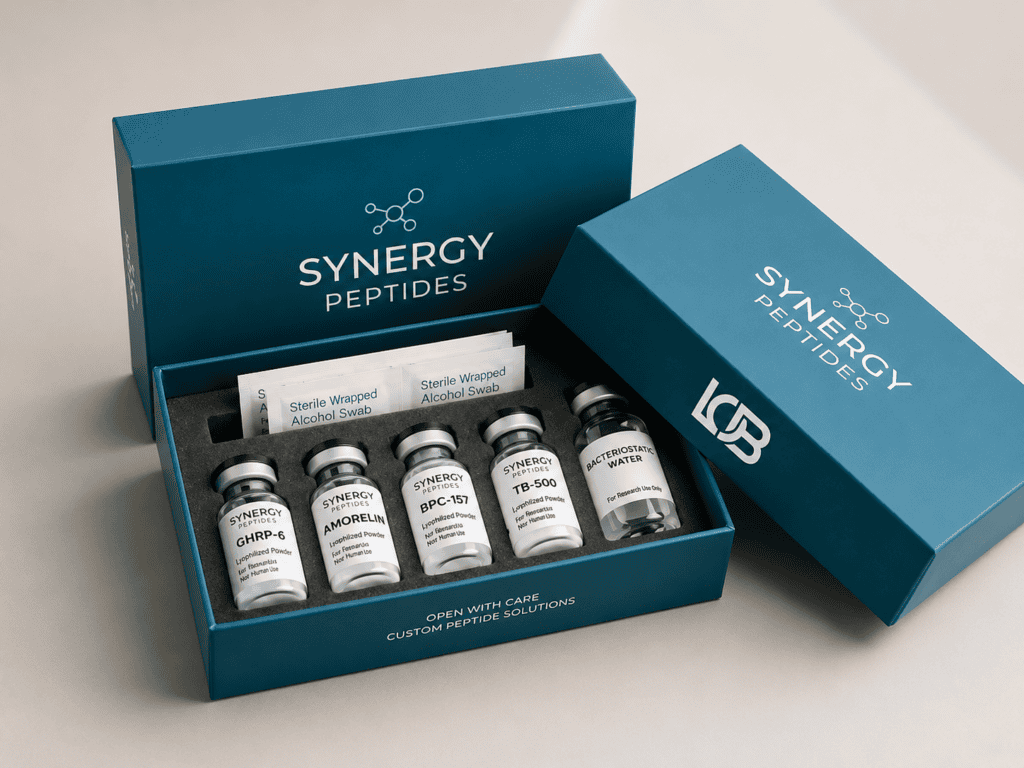
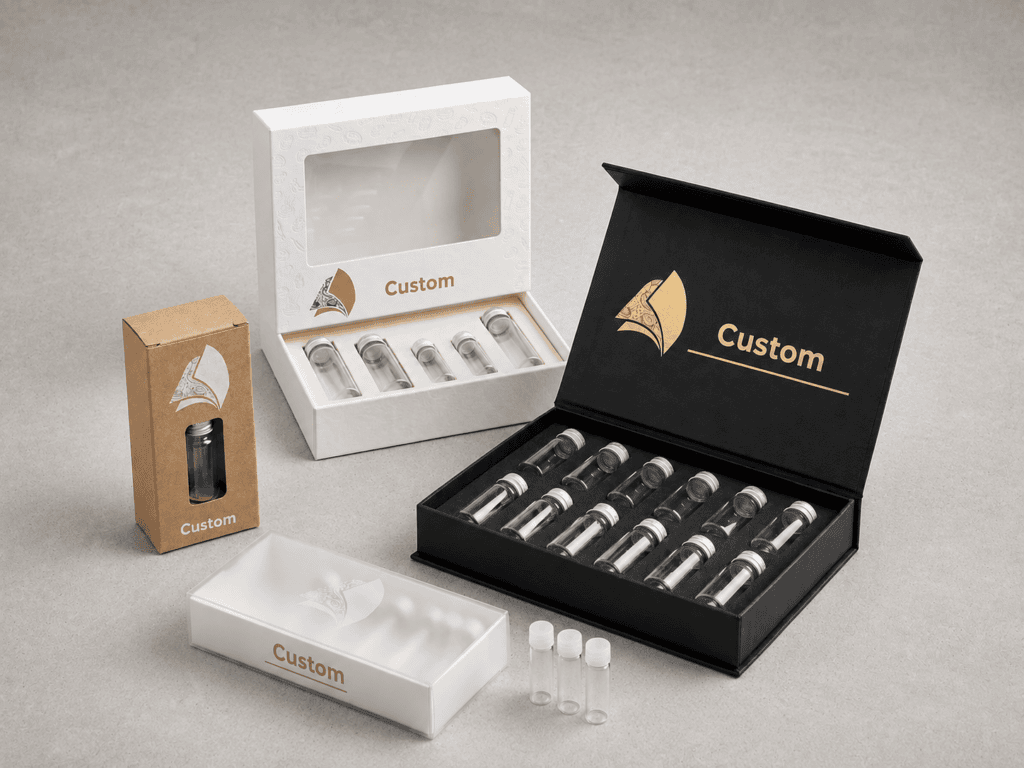
Current custom packaging suppliers increasingly build boxes around the actual vial rather than using a generic box size. They also offer cartons, rigid boxes, inserts, labels and multi-vial configurations.
That approach makes sense.
A vial should not move freely inside the carton.
Therefore, determine these specifications first:
vial diameter;
vial height;
cap diameter;
number of vials;
insert material;
carton structure;
transport requirements.
Only then should graphic design begin.
For a single-vial package, a simple folding carton may work.
Meanwhile, a multi-vial kit may require an EVA, cardboard or molded insert.
Premium rigid boxes look attractive.
However, they cost more and increase shipping volume.
Therefore, choose the structure according to the business model rather than visual preference alone.
A large Buyer order may favor efficient folding cartons.
Meanwhile, a sample kit may justify a rigid or reusable presentation case.
What Is Changing in Peptide Packaging in 2026?
Three trends deserve special attention.
1. Packaging qualification is becoming more risk-based
FDA’s August 2026 draft guidance emphasizes a risk-based framework for container closure systems and packaging-component quality control.
2. Functional testing matters more
USP <382> now strengthens the focus on how elastomeric components actually perform inside the complete packaging system.
3. Sustainability is moving into procurement decisions
The EU Packaging and Packaging Waste Regulation began applying from August 12, 2026. The regulation introduces broader packaging sustainability requirements. However, it also contains exemptions from some recycled-content requirements for immediate medicinal-product packaging and certain outer packaging required to preserve medicine quality.
Therefore, pharmaceutical packaging teams now need to balance:
product protection + compliance + sustainability.
Using less packaging is useful only when protection remains adequate.
Is Sustainable Peptide Packaging Possible?
Yes, especially in secondary and tertiary packaging.
For example, brands can reduce unnecessary plastic in:
outer cartons;
inserts;
shipping fillers;
printed literature.
They can also consider recyclable paperboard and better box sizing.
However, primary packaging requires more caution.
A vial or stopper directly protects the product.
Therefore, changing materials simply to improve an environmental claim can create compatibility or stability problems.
The new EU PPWR reflects this balance. Certain medicinal-product packaging receives exemptions from minimum recycled-content requirements where product quality and healthcare needs justify them.
Consequently, a sensible sustainability strategy looks like this:
optimize secondary packaging first
↓
reduce shipping volume
↓
simplify inserts
↓
evaluate recyclable materials
↓
change primary packaging only after qualification
This approach protects both product integrity and environmental goals.
How Do You Choose a Peptide Packaging Manufacturer?
Do not choose a supplier from box photos alone.
Instead, send a technical RFQ.
A useful RFQ should include:
Vial type
Example: Type I glass.
Vial dimensions
Diameter and total height.
Quantity
For example, pilot run versus mass production.
Number of SKUs
One design or 50 different peptide labels creates different printing economics.
Label requirements
Paper, film, moisture-resistant or cold-storage compatible.
Box type
Folding carton, rigid box or shipping kit.
Insert
Paperboard, EVA, foam or plastic tray.
Variable information
Lot, batch, barcode or QR fields.
Destination
Shipping environment can affect carton strength.
Current specialist packaging providers increasingly ask for vial dimensions, quantity, artwork, finish, insert design and destination before quoting.
That is a better purchasing model than simply asking:
Qualified CCS supported by compatibility, integrity and stability studies
Quality, sterility and regulatory suitability
Custom Private-Label Range
Standardized vial + modular label + common carton architecture
Scalability and SKU control
So, What Is the Best Peptide Packaging?
For many lyophilized peptide products, the most practical starting point is:
Type I glass vial + compatible stopper + crimp seal + batch-specific label + fitted secondary carton + shipping protection based on actual stability requirements.
However, that answer changes for liquid products, pharmaceutical injectables, cartridges and device-based systems.
Therefore, the correct packaging development order is:
Step 1 — Define the peptide format
Lyophilized or liquid?
Step 2 — Choose the primary container
Glass, polymer, cartridge or another validated option.
Step 3 — Match the closure system
Test the stopper, seal and container as a system.
Step 4 — Define storage conditions
Use actual stability data.
Step 5 — Design the label
Build in lot, batch and traceability information.
Step 6 — Design the secondary package
Fit the box around the finished vial.
Step 7 — Qualify transport packaging
Consider vibration, breakage and temperature.
Step 8 — Produce a pilot batch
Test everything before mass production.
That is the most practical answer to the question:
“How should peptide packaging be designed?”
Final Thoughts
The best peptide packaging does not begin with a logo.
It begins with the product.
First, define the formulation and primary container. Next, qualify the closure. Then establish storage requirements.
After that, design the label, carton and shipping system.
Moreover, 2026 regulatory developments make this technical approach even more relevant.
FDA is moving toward a clearer risk-based container-closure framework. USP now places stronger emphasis on elastomeric functional suitability. Meanwhile, the EU has entered a new packaging-sustainability phase.
Therefore, successful peptide packaging should balance five priorities:
Product protection
Container compatibility
Traceability
Transport performance
Brand presentation
If those five elements work together, packaging becomes more than decoration.
It becomes part of the product-quality system.
References
U.S. Food and Drug Administration. Container Closure Systems for Human Drugs and Biological Products — Draft Guidance for Industry. August 2026. The document introduces FDA’s current risk-based thinking for evaluating packaging materials, components and container-closure systems.
United States Pharmacopeia. USP <660> Containers—Glass. Type I glass provides high hydrolytic resistance and generally suits most parenteral applications.
United States Pharmacopeia. USP <381> Elastomeric Components in Injectable Pharmaceutical Product Packaging/Delivery Systems.
United States Pharmacopeia. USP <382> Elastomeric Component Functional Suitability in Parenteral Product Packaging/Delivery Systems.
United States Pharmacopeia. USP <1207> Package Integrity Evaluation—Sterile Products.
U.S. Food and Drug Administration / ICH. Q3E Guideline for Extractables and Leachables — Draft Guidance. November 2025.
ICH. Q1A(R2) Stability Testing of New Drug Substances and Products. Stability studies should evaluate the product in its proposed container-closure system.
European Commission. Packaging and Packaging Waste Regulation. New EU packaging rules began applying on August 12, 2026.
European Medicines Agency. Plastic Primary Packaging Materials. Covers pharmaceutical requirements for plastic immediate packaging.
Practical review of lyophilized biopharmaceutical development describing glass and polymer vial considerations for proteins and peptides.