Buy Semaglutide 10mg Exclusively at ALLGROWPEPTIDE
Semaglutide is a high-purity synthetic peptide that activates the glucagon-like peptide-1 receptor.
Researchers study this GLP-1 receptor agonist in metabolic, obesity, and endocrine research.
The molecule interacts with receptors involved in glucose regulation, appetite signaling, gastric emptying, and energy balance.
Controlled laboratory models help researchers examine these receptor-mediated pathways.
Semaglutide shows strong receptor affinity and an extended activity profile.
Its modified structure supports longer GLP-1 signaling than endogenous GLP-1.
Researchers can therefore study sustained receptor activity rather than short-lived hormonal responses.
This feature supports research involving insulin secretion, glucose regulation, lipid metabolism, and appetite-related signaling.
Its biochemical stability also supports long-term incretin research in complex experimental models.
Endocrinology research databases document many of these pathways and mechanisms.
Beta-Cell Function and Neuroendocrine Pathways
Researchers examine Semaglutide 10mg in pancreatic beta-cell signaling models.
They also investigate gastric emptying and central nervous system pathways related to satiety.
These models help researchers study interactions between metabolic hormones, neural signals, and endocrine feedback systems.
Scientists often compare Semaglutide with other incretin-based research compounds.
These comparisons reveal differences in receptor activation and downstream metabolic signaling.
Researchers may also examine adipose tissue responses under controlled experimental conditions.
Extended Pharmacokinetic Activity
Semaglutide has an optimized pharmacokinetic profile for extended laboratory observation.
Structural modifications help the peptide resist rapid degradation by the DPP-4 enzyme.
This resistance allows Semaglutide to remain active longer than native GLP-1.
Cellular assays can therefore show prolonged receptor binding and signaling activity.
Researchers can conduct extended observations without frequent compound replacement.
This extended activity supports longitudinal studies of metabolic adaptation.
It also supports research into cellular changes during sustained GLP-1 receptor engagement.
Lyophilized Semaglutide 10mg Format
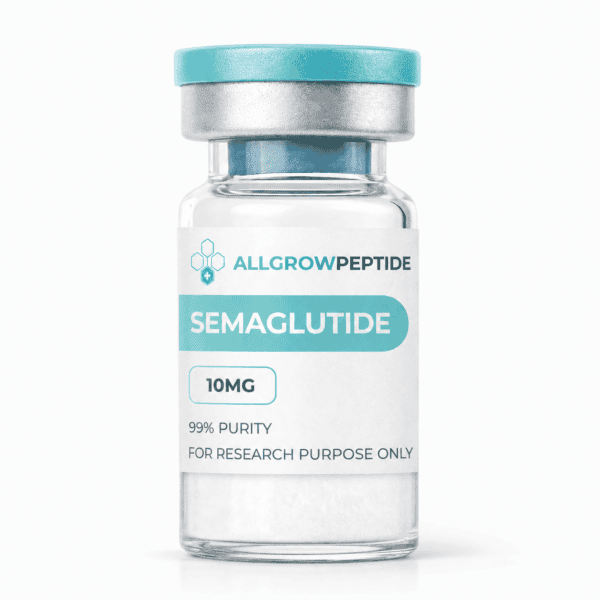
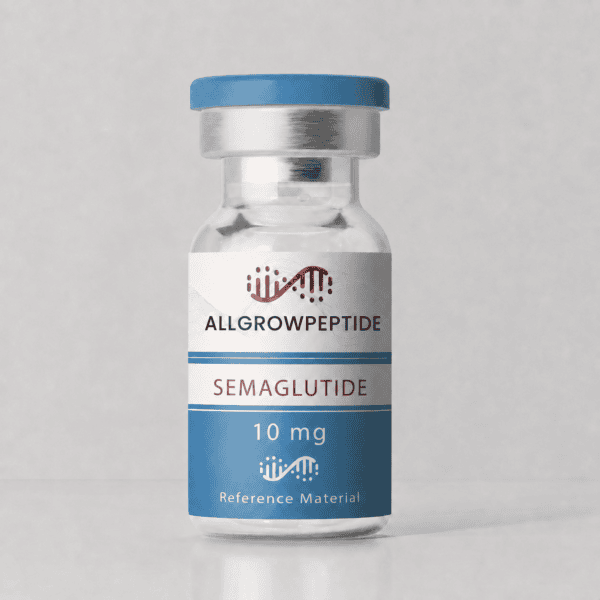
ALLGROWPEPTIDE supplies Semaglutide 10mg as sterile, lyophilized powder.
The freeze-dried format helps protect biochemical stability during storage.
It also supports accurate measurement and consistent laboratory handling.
Researchers should prepare and store the compound under controlled laboratory conditions.
The 10mg concentration supports extended protocols and detailed dose-response studies.
It also provides flexibility across various controlled metabolic research models.
Semaglutide 10mg: GLP-1 Signaling and Metabolic Research
Researchers use Semaglutide to investigate GLP-1 receptor signaling.
They study its influence on glucose-related and insulin-response pathways.
Scientists also examine appetite signaling, gastric emptying, and systemic energy regulation.
Controlled models can reveal how prolonged receptor activation affects downstream signaling.
Researchers may compare Semaglutide with other metabolic compounds from our extensive peptide library.
Careful comparisons can improve consistency across endocrine and metabolic studies.
Cold-Chain Storage and Stability
Researchers should use climate-controlled storage to protect the amino acid sequence.
Store unopened lyophilized vials according to documented laboratory requirements.
After reconstitution, researchers should refrigerate Semaglutide between 2°C and 8°C.
Stable refrigeration helps protect molecular structure and receptor-binding activity.
Researchers should avoid repeated temperature changes, contamination, and direct light exposure.
Careful storage improves consistency during extended laboratory studies.
Key Research Attributes
- High-stability synthetic GLP-1 receptor agonist
- Suitable for metabolic and endocrine signaling research
- Relevant to obesity-related laboratory models
- Supports glucose regulation and insulin-response studies
- Useful for appetite and gastric emptying research
- Applicable to energy balance and neuroendocrine studies
- Lyophilized format for accurate laboratory handling
- Designed strictly for controlled in-vitro research
Semaglutide continues to attract strong scientific interest.
Researchers value its robust receptor activity and extended signaling profile.
It remains important in peptide libraries focused on metabolic and endocrine research.
Scientists also use it in controlled weight-regulation and energy-balance models.
Disclaimer
ALLGROWPEPTIDE supplies Semaglutide 10mg strictly for laboratory research.
Do not use this product for human or animal consumption.
Do not use it for medical treatment or diagnostic procedures.
Researchers must follow all applicable laboratory regulations and institutional research standards.