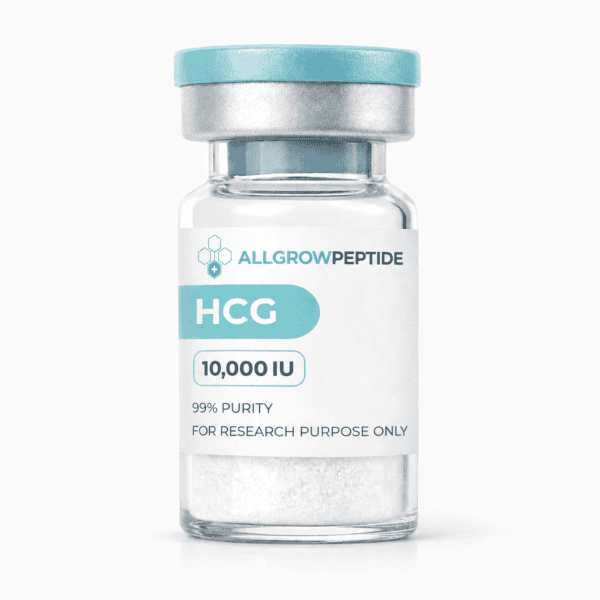
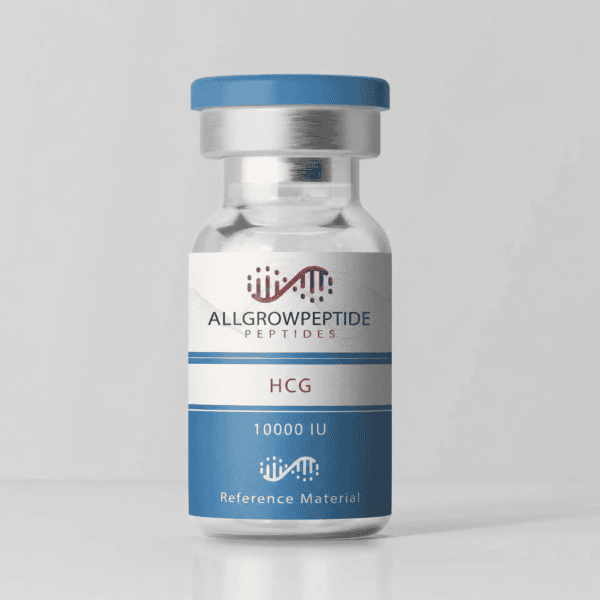
Buy HCG 10,000 IU Exclusively at ALLGROWPEPTIDE
HCG, or Human Chorionic Gonadotropin, is a research-grade peptide hormone for controlled endocrine studies.
Researchers use HCG to examine reproductive hormone pathways and endocrine signaling.
HCG shares structural and functional similarities with endogenous luteinizing hormone, or LH.
The molecule binds directly to LH receptors in controlled laboratory models.
This interaction helps researchers study hormonal communication, feedback mechanisms, and gonadotropic activity.
Scientists often investigate HCG in testicular and ovarian signaling models.
They also use it in steroidogenesis studies and HPG axis research.
HCG helps researchers examine testosterone synthesis, estrogen regulation, and reproductive endocrine balance.
These properties support in-vitro studies of hormone signaling and endocrine adaptation.
Researchers can compare HCG findings with data from established endocrinology databases.
cAMP Signaling and Steroidogenesis
Researchers study HCG for its role in receptor activation and cyclic AMP signaling.
They also examine its influence on hormone-related gene expression.
HCG has a longer biological half-life than endogenous LH.
This feature allows scientists to observe sustained receptor activation and extended endocrine responses.
Researchers can therefore evaluate hormonal timing, signaling intensity, and regulatory control.
Endocrinologists also study HCG pharmacokinetics through controlled cellular assays.
They measure receptor binding affinity, degradation rates, and downstream transcription.
Researchers often use Leydig cells or granulosa cells in these models.
These models help scientists investigate age-related endocrine changes and cellular hormone responses.
They also support studies of biochemical pathways linked to endocrine function.
HCG for Precision Endocrine Research
This formulation supports precision research protocols and controlled laboratory studies.
Researchers can use it in dose-response studies, comparative research, and extended experiments.
Careful handling improves consistency, stability, and repeatability across research applications.
Accurate reconstitution also supports reliable molarity across experimental batches.
Researchers should calculate each concentration carefully before starting cellular assays.
Controlled Reconstitution and Cold-Chain Storage
Researchers must protect the peptide structure during storage and handling.
They should follow strict cold-chain procedures at every stage.
After researchers reconstitute HCG with bacteriostatic water, they should refrigerate it between 2°C and 8°C.
Stable refrigeration helps protect molecular integrity during longer studies.
Researchers should avoid repeated temperature changes and direct light exposure.
Laboratories can compare HCG with compounds from our extensive peptide library.
These comparisons may support broader endocrine and biochemical research.
Key Research Attributes
- Premium research-grade Human Chorionic Gonadotropin
- Structurally and functionally related to endogenous luteinizing hormone
- Suitable for endocrine and reproductive signaling research
- Useful for HPG axis and gonadotropic pathway studies
- Relevant to steroidogenesis and hormone regulation models
- Supports controlled dose-response and receptor-binding studies
- Designed only for controlled laboratory and in-vitro research
HCG remains an important compound in reproductive and endocrine research.
Researchers value its well-characterized receptor activity and consistent laboratory performance.
Its established profile supports continued investigation of complex hormonal signaling systems.
Disclaimer
ALLGROWPEPTIDE supplies HCG strictly for laboratory research use.
Do not use this product for human or animal consumption.
Do not use it for treatment, diagnosis, or clinical procedures.
Researchers must follow all applicable laboratory regulations and research standards.