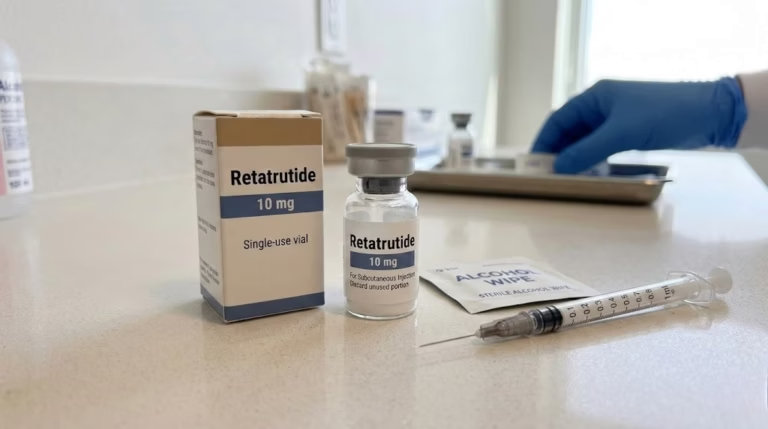
RT10mg commonly refers to a 10 mg research presentation of Retatrutide, also known as LY3437943.
However, a vial label alone cannot confirm peptide quality.
Laboratories need evidence for identity, purity, quantity, and batch consistency. Therefore, analytical testing plays a central role in RT10mg research.
Retatrutide is an engineered peptide ligand. Published research describes it as a 39-amino-acid peptide with agonist activity at GIPR, GLP-1R, and GCGR.
Its multi-receptor profile makes analytical consistency especially important. Small changes in peptide integrity may complicate quantitative receptor experiments.
This article explains how researchers can evaluate RT10mg material before laboratory use. It focuses on HPLC, LC-MS, Certificates of Analysis, batch comparison, storage, and reproducibility.
For Research Use Only. Not for human use.
What Does RT10mg Mean?
RT10mg is primarily a catalog and search term.
In this context:
RT refers to Retatrutide.
10mg describes the nominal material quantity.
LY3437943 identifies the research molecule.
Therefore, RT10mg does not describe a different Retatrutide analog.
It also does not indicate purity.
Likewise, it does not describe solution concentration.
Researchers should separate these concepts when creating laboratory records.
For example, a sample might carry a nominal label of 10 mg. Meanwhile, its HPLC chromatogram may report a separate purity value.
Those measurements answer different questions.
Scientific Profile of RT10mg Retatrutide
Retatrutide belongs to the modified peptide class.
IUPHAR classifies LY3437943 as a peptide agonist of GIPR, GLP-1R, and GCGR. The molecule also contains lipidation designed to alter its biological behavior.
Published research describes a 39-amino-acid scaffold linked to a C20 fatty diacid group.
Common chemical databases and research reagent sources report a molecular mass near 4731.33 Da.
These characteristics create several analytical challenges.
First, Retatrutide is much larger than a typical small molecule.
Lyophilized material generally requires strong moisture control.
Therefore, laboratories should keep containers tightly sealed.
Repeated temperature cycling can also introduce condensation.
Consequently, unnecessary warming and cooling should be minimized.
After solution preparation, stability becomes formulation-dependent.
Researchers should validate the chosen buffer for critical experiments.
Common Causes of Peptide Degradation
Synthetic peptides can follow several degradation pathways.
Oxidation
Certain residues can oxidize.
Mass spectrometry may detect corresponding mass shifts.
Deamidation
Some amino-acid side chains can undergo deamidation.
The rate depends strongly on sequence and pH.
Hydrolysis
Peptide bonds or side-chain structures can degrade under unfavorable conditions.
Aggregation
Peptide molecules may associate physically.
This can reduce the available soluble fraction.
Surface Adsorption
Peptides may bind to plastic or glass surfaces.
The effect becomes more important at low concentrations.
Therefore, container selection can matter during quantitative studies.
How to Evaluate an RT10mg Supplier for Laboratory Research
Researchers should focus on evidence rather than slogans.
Useful questions include:
Does the supplier identify LY3437943 clearly?
Does each batch have a traceable lot number?
Is HPLC documentation available?
Is mass-spectrometry identity data available?
Does the COA match current inventory?
Can repeat batches be documented?
Does the supplier distinguish research material from human use?
The existing ALLGROW RT10 page already identifies Retatrutide, LY3437943, the 10 mg presentation, 39-amino-acid structure, and three receptor systems.
Those data create a useful starting point.
However, researchers should still review the current batch COA.
Frequently Asked Questions About RT10mg
What is RT10mg?
RT10mg commonly describes a 10 mg research presentation of Retatrutide. The molecule is also known as LY3437943. Retatrutide is a modified peptide that activates GIPR, GLP-1R, and GCGR. The term “10mg” describes a nominal material quantity. It does not define purity or concentration.
Is RT10mg the same as Retatrutide?
RT10mg usually functions as a short catalog term for Retatrutide 10mg. However, laboratory records should use Retatrutide or LY3437943. These names provide clearer molecular identification.
How many amino acids are in Retatrutide?
Published literature describes Retatrutide as a 39-amino-acid peptide. It also contains a C20 fatty diacid modification.
What is the molecular weight of Retatrutide?
Research reagent databases commonly report a molecular weight of approximately 4731.33 Da.
Does HPLC confirm RT10mg identity?
Not by itself. HPLC primarily evaluates chromatographic behavior and purity. Therefore, laboratories often combine HPLC with LC-MS or another orthogonal identity method.
Why does RT10mg need mass-spectrometry testing?
Mass spectrometry supports identity by measuring mass-to-charge ratios. For modified peptides, it can also reveal several degradation-related mass changes.
Is an HPLC purity percentage enough to compare suppliers?
No. Method conditions affect chromatographic results. Therefore, researchers should review the method, chromatogram, lot number, and complementary identity testing.
What should an RT10mg COA contain?
A useful COA should include the compound name, lot number, analytical date, HPLC result, and identity data. Where possible, researchers should also review the underlying chromatogram and spectrum.
Can different RT10mg batches be used in one study?
Yes, but researchers should consider a bridging assessment. Comparing chromatography, mass data, concentration, and functional response can reduce batch-related uncertainty.
Is Retatrutide approved for human use?
Retatrutide remains investigational as of August 2026. Lilly continues to describe it as an investigational triple hormone receptor agonist.
Conclusion
RT10mg quality assessment requires several independent measurements.
A batch-specific COA then connects these results to the physical research sample.
Retatrutide is a modified 39-amino-acid triple agonist peptide. Therefore, reliable identity and batch consistency matter in quantitative receptor experiments.
Researchers should ultimately treat purity, identity, quantity, and biological activity as separate quality attributes.
That approach produces stronger laboratory records.
More importantly, it supports reproducible research.
For Research Use Only. Not for human use.
References
Coskun T, et al. LY3437943, a novel triple glucagon, GIP, and GLP-1 receptor agonist. Cell Metabolism. 2022.
IUPHAR/BPS Guide to Pharmacology. Retatrutide / LY3437943 ligand record.
Goldney J, et al. Review of GLP-1/GIP/GCGR triple agonism and Retatrutide molecular design.
FDA. Mounjaro (tirzepatide) prescribing information. Molecular weight and receptor profile.
FDA. Semaglutide prescribing information. Molecular structure and molecular weight.
Lilly. Retatrutide Phase 3 TRIUMPH-1 update. May 21, 2026.