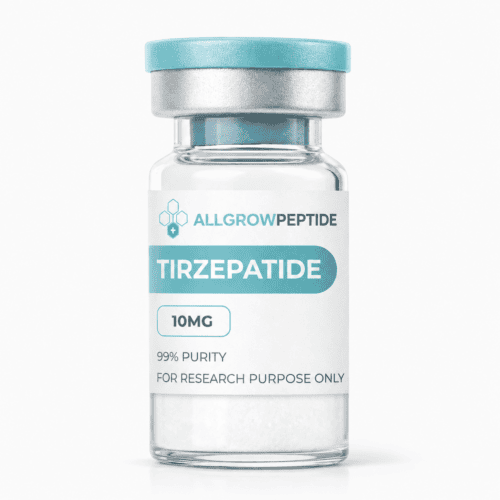
Tirzepatide 20mg: Product Overview
Tirzepatide 20mg is a synthetic research peptide characterized by its dual activity at the glucose-dependent insulinotropic polypeptide receptor (GIPR) and glucagon-like peptide-1 receptor (GLP-1R).
Unlike compounds that selectively activate a single incretin receptor, tirzepatide interacts with both receptor systems. This molecular characteristic has attracted scientific interest in receptor pharmacology, cellular signaling, and the regulation of metabolic pathways.
Structurally, tirzepatide is a modified 39-amino-acid peptide containing a C20 fatty-diacid moiety attached through a linker. These structural features influence receptor interactions and molecular pharmacology.
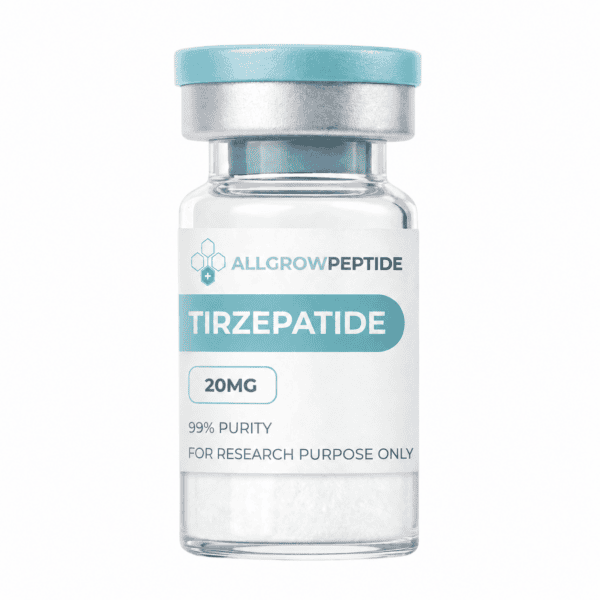
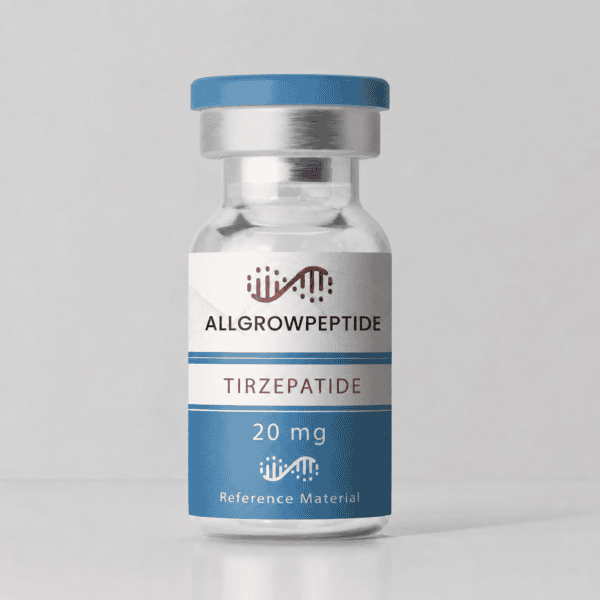
The 20mg designation refers to the nominal amount of peptide supplied per vial. It does not describe a recommended experimental concentration or administration dose.
ALLGROWPEPTIDE lists this product in a lyophilized powder format for laboratory research. Researchers and purchasing teams should review current batch specifications, analytical documentation, and applicable regulations before obtaining or using the material.
Tirzepatide 20mg Product Specifications
Accurate product identification is important for scientific reproducibility and laboratory procurement. The following table combines established molecular information with specifications currently advertised for the product.
| Parameter | Specification |
|---|
| Product Name | Tirzepatide 20mg |
| CAS Number | 2023788-19-2 |
| Molecular Formula | C225H348N48O68 |
| Molecular Weight | Approximately 4813.45 g/mol |
| Peptide Length | 39 amino acids |
| Molecular Class | Synthetic dual GIP/GLP-1 receptor agonist |
| Molecular Modification | C20 fatty-diacid conjugation |
| Nominal Content | 20mg per vial |
| Physical Form | Lyophilized powder |
| Listed Average Purity | ≥99%; confirm actual lot results |
| Intended Application | Controlled laboratory research |
| Quality Documentation | Request lot-specific COA and analytical records |
Note: Molecular properties are supported by published chemical and scientific references. Product-specific values, including purity and net content, should be verified against the current batch documentation.
Molecular Characteristics
Tirzepatide is derived from a modified peptide sequence that incorporates structural elements important for dual incretin receptor activity.
Its C20 fatty-diacid side chain contributes to albumin binding and influences the molecule’s pharmacokinetic characteristics. Specific sequence modifications also contribute to its distinctive receptor interactions.
These features distinguish tirzepatide from endogenous incretin peptides and make it relevant to investigations involving peptide structure, receptor selectivity, and ligand-receptor interactions.
Researchers should distinguish the molecular characteristics established in published studies from the measured properties of an individual commercial research batch.
Dual GIP and GLP-1 Receptor Signaling Research
The scientific significance of tirzepatide lies primarily in its interaction with two incretin receptor systems.
GIPR and GLP-1R are members of the G protein-coupled receptor family. Both participate in biological signaling networks associated with metabolic regulation.
Their combined activation provides a useful subject for investigating how receptor systems interact in experimental models.
GIP Receptor Signaling
Glucose-dependent insulinotropic polypeptide is an incretin hormone involved in nutrient-responsive signaling.
Its receptor, GIPR, is expressed in several tissues and has been studied in relation to endocrine signaling, cellular responses, and metabolic regulation.
Laboratory investigations involving GIPR commonly examine receptor activation, intracellular signaling, ligand binding, and interactions with other regulatory pathways.
Tirzepatide provides a molecular example for comparing dual-receptor pharmacology with the activity of more selective receptor ligands.
GLP-1 Receptor Signaling
Glucagon-like peptide-1 receptor signaling has been widely investigated in endocrine and molecular biology research.
GLP-1R is a G protein-coupled receptor that can activate intracellular signaling pathways, including those involving cyclic adenosine monophosphate (cAMP).
Research into GLP-1R pharmacology may examine receptor activation, signaling kinetics, receptor internalization, and cellular responses.
Published structural studies have also investigated how tirzepatide interacts differently with GIPR and GLP-1R.
These observations support further investigation of receptor-specific molecular interactions. However, experimental findings depend on the model, methods, and conditions used.
Why Dual-Receptor Activity Matters
Dual-receptor pharmacology allows scientists to examine molecular interactions involving more than one receptor target.
This can provide opportunities to compare receptor activation patterns, signaling responses, and ligand selectivity within appropriately validated research systems.
When interpreting published findings, researchers should consider differences in experimental models, receptor expression levels, assay design, and measurement techniques.
The presence of dual-receptor activity does not mean that every biological effect will be identical across laboratory systems.
Research Applications and Experimental Considerations
Tirzepatide has been investigated in scientific research relating to incretin receptor biology and molecular signaling.
Relevant areas of laboratory investigation include:
Receptor Binding and Molecular Recognition
Researchers may examine how the peptide interacts with the binding regions of GIPR and GLP-1R.
Structural biology methods, receptor assays, and molecular modeling can contribute to understanding these interactions.
Published cryo-electron microscopy studies have provided important information about the molecular determinants of tirzepatide receptor activity.
Intracellular Signaling Pathways
Controlled cellular models can be used to investigate signaling responses associated with incretin receptor activation.
Depending on the validated experimental system, investigators may examine cAMP-associated pathways, receptor behavior, and downstream signaling events.
Appropriate control groups and validated assay methods are essential for interpreting the results.
Peptide Structure and Receptor Selectivity
The structural modifications of tirzepatide make it relevant to broader research into peptide design.
Scientists can use published information about the molecule to understand how amino acid substitutions, lipid conjugation, and receptor-binding characteristics relate to peptide pharmacology.
Research Reproducibility
Reliable experimental interpretation depends on more than molecular identity alone.
Material characterization, analytical documentation, handling conditions, and batch consistency can all affect reproducibility.
Laboratories should establish their own validated procedures and review the relevant technical information before beginning experimental work.
Quality Control and Batch Documentation
For research peptide procurement, quality assessment should be based on analytical evidence rather than general marketing descriptions.
ALLGROWPEPTIDE lists an average purity of at least 99% for Tirzepatide. However, the analytical result for a specific lot should be confirmed through its Certificate of Analysis (COA).
High-Performance Liquid Chromatography (HPLC)
High-performance liquid chromatography is commonly used to evaluate peptide purity and investigate impurities.
When reviewing an HPLC report, researchers should consider the reported purity, analytical method, chromatographic profile, and relationship between the report and the supplied batch.
An HPLC purity percentage alone does not establish peptide identity, net peptide content, sterility, or suitability for every research application.
Mass Spectrometry (MS)
Mass spectrometry can support molecular identity assessment by comparing observed analytical signals with the expected characteristics of the compound.
For a research peptide, MS data can provide complementary information alongside chromatographic analysis.
The availability and scope of testing should be verified for the specific batch.
Certificate of Analysis (COA)
A useful COA should clearly identify the material and the batch to which the results apply.
Depending on the tests performed, the document may include:
- Product name and batch identifier
- Reported purity and analytical method
- Molecular identity information
- Test date and specification limits
- Relevant analytical observations
Not every COA contains the same set of tests. Buyers should request any additional analytical information required for their experimental application.
For more information about documentation, visit our Certificate of Analysis and Batch Documentation page.
Lyophilized Format, Packaging, and Storage
The product is listed in a lyophilized, or freeze-dried, powder format.
Lyophilization removes water through a controlled freeze-drying process and is commonly used in peptide manufacturing and formulation.
However, the physical format alone does not establish a specific shelf life or guarantee stability under all conditions.
Product Packaging
Before purchasing, laboratories should confirm the vial specification, label information, package contents, and any special documentation requirements.
For institutional procurement, relevant packaging details may include the batch number, nominal peptide content, product identity, and traceability information.
Storage and Handling
Peptide stability depends on the molecular structure, formulation, packaging, moisture exposure, and storage conditions.
Researchers should follow the storage instructions and stability information applicable to the supplied batch.
A universal temperature range or post-reconstitution shelf life should not be assumed without suitable supporting data.
The material should be handled by trained personnel using appropriate institutional laboratory procedures.
Laboratory Procurement and Supply Inquiries
Research institutions and authorized commercial laboratories often require clear technical documentation before approving peptide purchases.
ALLGROWPEPTIDE provides information about peptide products and related services, including batch documentation and custom packaging.
For a Tirzepatide 20mg procurement inquiry, buyers should identify their organization, intended laboratory research application, anticipated quantity, and destination country.
What to Confirm Before Ordering
The supplier and purchasing institution should verify the following information before proceeding:
- Current product specification and available batch
- Lot-specific purity and identity documentation
- Nominal peptide content and packaging format
- Minimum order quantity and applicable quotation terms
- Appropriate shipping conditions and export documentation
- Eligibility for supply under applicable laws and regulations
Custom labeling or packaging requirements can be discussed separately, subject to supplier capability and local regulatory restrictions.
Product availability, pricing, and shipping eligibility should be confirmed directly rather than assumed from general website descriptions.
Frequently Asked Questions About Tirzepatide 20mg
What is Tirzepatide 20mg?
Tirzepatide 20mg refers to a research product containing a nominal 20mg quantity of tirzepatide per vial. Tirzepatide is a synthetic peptide with dual GIPR and GLP-1R agonist activity. The listed quantity should be verified against the product label and relevant batch documentation.
What is the molecular weight of tirzepatide?
The molecular weight of tirzepatide is approximately 4813.45 g/mol. This value refers to the molecular structure of the compound and is not a batch-specific purity measurement.
What does a purity specification of ≥99% mean?
A purity value of at least 99% indicates a reported analytical purity threshold under a specified testing method. It does not independently establish the peptide’s identity, absolute content, sterility, or freedom from every possible impurity. Actual batch results should be reviewed in the relevant COA.
What is the difference between Tirzepatide 10mg and 20mg?
The nominal peptide quantity is the primary distinction between a 10mg and a 20mg vial of the same molecular compound. The stated quantity does not, by itself, indicate a difference in molecular structure or purity.
Purchasers should compare the specific product labels, analytical records, and batch specifications rather than relying on vial size alone.
Why is tirzepatide studied in receptor research?
Tirzepatide interacts with both GIP and GLP-1 receptors. This dual-receptor activity makes it relevant to molecular investigations of ligand recognition, receptor signaling, and incretin-related cellular pathways.
Published structural and pharmacological studies provide the scientific basis for this interest.
Can a Certificate of Analysis be requested?
Buyers can inquire about the current batch COA and the availability of supporting analytical data. Documentation should be matched to the actual batch being supplied.
How should Tirzepatide 20mg be stored?
Storage requirements should be based on product-specific stability information and the supplier’s documented instructions.
Researchers should not assume a fixed shelf life, storage temperature, or solution stability period without appropriate evidence.
Is this research product intended for human use?
No. This listed research product is not presented as a medicine or as an approved injectable formulation. It is not intended for human or veterinary administration, clinical treatment, self-medication, or diagnostic use.
The research-use designation does not override applicable pharmaceutical regulations.
Request Product Documentation
For laboratory procurement inquiries concerning Tirzepatide 20mg, contact ALLGROWPEPTIDE to request current product specifications and available batch documentation.
Please include your organization, research application, required quantity, and destination country so that the supplier can review the request and applicable supply requirements.
Email: [email protected]
Important Research Disclaimer
This product is intended solely for lawful, controlled laboratory research by appropriately qualified personnel. It is not intended for human or veterinary use, clinical administration, self-medication, or diagnostic applications. The research-only designation does not establish regulatory authorization. Procurement, distribution, and use must comply with the laws applicable in the relevant jurisdiction.
Scientific References
- PubChem. Tirzepatide, CID 163285897. Molecular formula, molecular mass, and chemical identifiers.
https://pubchem.ncbi.nlm.nih.gov/compound/163285897 - Structural Determinants of Dual Incretin Receptor Agonism by Tirzepatide. Proceedings of the National Academy of Sciences, 2022.
https://pubmed.ncbi.nlm.nih.gov/35333651/ - Designing a Dual GLP-1R/GIPR Agonist from Tirzepatide: Comparing Residues Between Tirzepatide, GLP-1, and GIP. Drug Design, Development and Therapy, 2022.
https://pubmed.ncbi.nlm.nih.gov/35651477/ - Molecular Pharmacology of the Incretin Receptors. Peptides, 2015.
https://pmc.ncbi.nlm.nih.gov/articles/PMC5588519/