



首页 » RT10 peptide
Retatrutide 10mg (RT10) Research Peptide
Retatrutide 10mg, also searched as RT10 peptide, is a laboratory research format of the investigational peptide LY3437943.
Researchers study this molecule because it interacts with three receptor systems: GIP, GLP-1 and glucagon receptors. Therefore, it provides a useful model for investigating multi-receptor metabolic signaling.
Published literature describes Retatrutide as a 39-amino-acid peptide engineered from a GIP-based peptide backbone. Researchers developed the molecule to produce activity across all three receptor pathways.
ALLGROW supplies RT10 for qualified laboratory and analytical research applications.
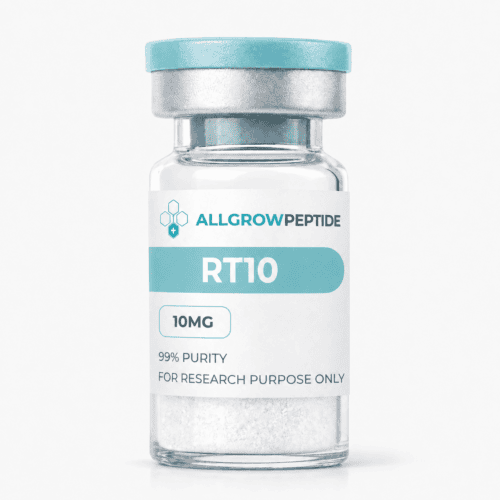
Quick Product Information
- Product Name: Retatrutide
- Common Search Name: RT10 Peptide
- Research Identifier: LY3437943
- Quantity: 10 mg per vial
- Molecular Type: Modified peptide
- Peptide Length: 39 amino acids
- Receptor Research Profile: GIPR / GLP-1R / GCGR
- Physical Form: Lyophilized powder
- Analytical Documentation: Batch-specific documentation available
- Intended Use: Laboratory and analytical research only
Retatrutide contains 39 amino acids and includes structural modifications designed to support its pharmacological research profile. Published research also describes a C20 fatty diacid modification.
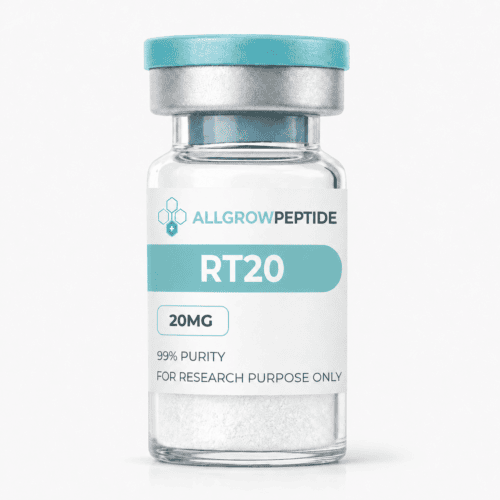
RT10 Peptide Technical Specifications
Researchers should evaluate peptide materials using more than a product name or nominal vial quantity.
For example, identity, chromatographic purity and lot traceability provide separate pieces of information. Therefore, procurement teams should review these parameters independently.
| Specification | RT10 Research Information |
|---|---|
| Compound | Retatrutide |
| Research Identifier | LY3437943 |
| Common SKU | RT10 |
| Quantity | 10 mg per vial |
| Peptide Length | 39 amino acids |
| Format | Lyophilized powder |
| Research Class | Triple receptor agonist |
| Receptor Systems | GIP, GLP-1 and glucagon |
| Purity | Review current batch COA |
| Identity Testing | Mass spectrometry documentation where available |
| Intended Use | Laboratory research only |

What Is Retatrutide (LY3437943)?
Retatrutide is an investigational synthetic peptide.
Scientific literature refers to it as LY3437943. Researchers engineered the molecule from a GIP-related peptide backbone.
Unlike a single-pathway peptide, Retatrutide interacts with three receptor systems.
These include:
GIP receptor — GIPR
Researchers examine this pathway in glucose-dependent signaling and metabolic regulation.
GLP-1 receptor — GLP-1R
This pathway plays an important role in incretin and metabolic research.
Glucagon receptor — GCGR
Researchers study this pathway in glucose regulation, hepatic signaling and energy metabolism.
Consequently, Retatrutide provides a model for studying how several endocrine pathways interact within one molecular system.
The original preclinical publication describes LY3437943 as a single peptide engineered for activity at glucagon, GIP and GLP-1 receptors.

Why Is Retatrutide Called a Triple Agonist?
The term triple agonist describes Retatrutide more accurately than the popular online term “GLP-3.”
Retatrutide activates three different receptor families:
GIPR + GLP-1R + GCGR.
Therefore, researchers can examine combined receptor signaling rather than studying each pathway separately.
This distinction also improves scientific accuracy.
Eli Lilly specifically states that “GLP-3” is an informal and scientifically inaccurate description. Instead, Lilly describes Retatrutide as a triple hormone receptor agonist.
For SEO purposes, “GLP-3” may still appear once in an FAQ. However, it should not become the primary scientific product name.
Molecular Design and Research Characteristics
Retatrutide differs from an unmodified endogenous peptide.
Published molecular research describes LY3437943 as a 39-amino-acid single peptide.
Researchers introduced several non-natural amino acids into the structure. In addition, the molecule contains a C20 fatty diacid attached through a modified lysine position.
These modifications contribute to its experimental pharmacological properties.
Furthermore, published work reports stronger GIP receptor potency alongside activity at GLP-1 and glucagon receptors.
This molecular architecture makes Retatrutide useful for several research questions.
For example, investigators can examine:
- multi-receptor signaling;
- peptide-receptor interactions;
- receptor selectivity;
- metabolic pathway cross-talk;
- structure-activity relationships;
- endocrine pathway modeling;
- pharmacokinetic behavior;
- comparative agonist research.
These applications describe scientific research areas only.
They do not represent therapeutic recommendations.
Published Retatrutide Research Data
Peer-reviewed clinical studies provide useful context for understanding LY3437943.
However, clinical research data should never serve as a specification for an RT10 research vial.
The two are different.
For example, the 2023 Phase 2 obesity study included 338 adults. Researchers evaluated several Retatrutide dose groups for 48 weeks.
At week 48, the published mean body-weight changes included:
- 1 mg group: −8.7%
- 4 mg combined group: −17.1%
- 8 mg combined group: −22.8%
- 12 mg group: −24.2%
- placebo: −2.1%
These figures come directly from the controlled clinical study.
They should appear only as published scientific context.
They must not imply that a laboratory RT10 vial provides an approved medical outcome.
| Research Stage | Reference Data | Scientific Context |
|---|---|---|
| Preclinical | 39-amino-acid triple agonist | GIPR, GLP-1R and GCGR research |
| Phase 1b | 72 participants | Safety, PK and pharmacodynamic investigation |
| Phase 1b PK | Approx. 6-day half-life | Reported for LY3437943 in the controlled study |
| Phase 2 | 338 participants | 48-week randomized study |
| Phase 2, 12 mg arm | −24.2% mean body-weight change at week 48 | Clinical study result, not a product claim |
| Phase 3 | Multiple TRIUMPH studies | Clinical development remains ongoing |
The Phase 1b publication reported approximately a six-day half-life for LY3437943 under the study conditions.
Meanwhile, Lilly reported additional Phase 3 results in July 2026. The company also stated that Retatrutide remains investigational.

Current Retatrutide Research Status
As of August 2026, Retatrutide has not received FDA approval.
Lilly continues to describe the compound as investigational.
The company has disclosed Phase 3 data from several Retatrutide studies. Additional research also remains underway.
In July 2026, Lilly reported results from TRIUMPH-2 and TRIUMPH-3.
TRIUMPH-2 randomized 1,152 participants.
TRIUMPH-3 randomized 1,949 participants.
Both studies lasted 80 weeks.
However, these clinical programs evaluate Lilly’s investigational drug candidate.
They do not validate third-party research peptide products.
Therefore, buyers should assess research materials through their own analytical documentation and institutional requirements.
RT10 Research Applications
Laboratories may investigate Retatrutide in several controlled scientific settings.
Multi-Receptor Signaling Research
Retatrutide allows researchers to study three receptor systems using one peptide model.
This makes it useful for comparative receptor experiments.
Researchers may evaluate downstream signaling responses after receptor activation.
GLP-1 Receptor Research
GLP-1 receptor signaling remains an important area of metabolic biology.
Therefore, Retatrutide can support comparative studies involving single, dual and triple receptor systems.
GIP Receptor Research
GIPR represents another central part of Retatrutide’s research profile.
Investigators may examine receptor activation, signaling strength and pathway interactions.
Glucagon Receptor Research
The glucagon component separates Retatrutide from many dual incretin agonist models.
As a result, researchers can investigate how GCGR activity changes a multi-receptor experimental system.
Structure-Activity Relationship Studies
Retatrutide contains several molecular modifications.
Therefore, researchers may compare its structural characteristics with other engineered peptide agonists.
Comparative Peptide Research
Researchers can also compare Retatrutide with related research models.
Examples include GLP-1-focused compounds and GIP/GLP-1 dual agonist systems.
However, each molecule has a different receptor profile.
Retatrutide vs. Tirzepatide vs. Semaglutide in Research
Researchers should not group all incretin-related molecules together.
Their receptor profiles differ.
| Compound | Primary Research Targets | Research Classification |
|---|---|---|
| Semaglutide | GLP-1R | Single receptor agonist model |
| Tirzepatide | GIPR + GLP-1R | Dual receptor agonist model |
| Retatrutide | GIPR + GLP-1R + GCGR | Triple receptor agonist model |
This difference makes receptor architecture an important variable in experimental design.
Therefore, laboratories should choose compounds according to the signaling pathway they intend to investigate.
RT10 Peptide Quality Control and Batch Verification
A product label cannot establish peptide quality by itself.
Instead, researchers should examine several analytical factors.
1. HPLC Purity
High-performance liquid chromatography can evaluate chromatographic purity under specified analytical conditions.
However, an HPLC percentage does not independently confirm every aspect of product quality.
It does not automatically confirm peptide identity.
Therefore, researchers should review other analytical results as well.
2. Mass Spectrometry
Mass spectrometry can support molecular identity assessment.
When available, the measured molecular-ion information should correspond with the expected compound.
3. Batch Number
Every analytical document should connect to a specific lot or batch.
This helps procurement teams maintain traceability.
4. Test Date
Analytical reports should include a test or reporting date.
Otherwise, buyers cannot easily determine whether a COA corresponds with current inventory.
5. Sample Identification
The product name on the COA should match the purchased material.
For RT10, documentation should clearly identify Retatrutide / LY3437943.
6. Quantity Verification
Purity and quantity represent different measurements.
Therefore, chromatographic purity alone does not prove the amount of peptide inside a vial.
This distinction matters when evaluating research materials.

What Should a Retatrutide COA Include?
A useful Certificate of Analysis should provide enough information to connect a test result with a physical batch.
For example, researchers should look for:
- compound name;
- batch or lot number;
- sample identification;
- analytical method;
- purity result;
- identity result where tested;
- testing date;
- laboratory information;
- product quantity information where tested.
Several current high-ranking research peptide suppliers now place COA and lot verification prominently on product pages.
However, ALLGROW should go one step further.
Instead of simply writing “99% purity,” connect each claim to the relevant batch document.
That approach improves transparency and E-E-A-T.
How Laboratories Can Evaluate an RT10 Supplier
Price alone provides very little scientific information.
Instead, researchers and procurement teams can use a simple verification process.
Step 1: Confirm Compound Identity
Check whether the supplier clearly identifies the product as:
Retatrutide / LY3437943 / RT10 10mg
Avoid pages that rely only on vague names such as “GLP-3.”
Step 2: Request Batch Documentation
Ask for the corresponding COA.
Then compare the lot number with the supplied material.
Step 3: Review the Analytical Method
Look for information about HPLC and identity testing.
Do not treat a generic “lab tested” badge as analytical evidence.
Step 4: Check Quantity Information
Confirm whether “10 mg” describes nominal filling quantity or an independently measured result.
Those are not automatically identical.
Step 5: Review Traceability
A research supplier should maintain batch records.
This becomes particularly important for repeat projects.
Step 6: Confirm Research-Only Positioning
A professional laboratory supplier should avoid medical dosing instructions and consumer treatment claims.
Retatrutide remains investigational and unapproved.

Practical Procurement Example — Selecting RT10 for a Research Project
Consider a laboratory planning a comparative receptor-signaling study.
The team wants to compare:
- a GLP-1 receptor model;
- a dual GIP/GLP-1 receptor model;
- a triple GIP/GLP-1/glucagon receptor model.
The laboratory identifies Retatrutide as the triple agonist reference compound.
However, the purchasing team should not start with price.
First, the team confirms the compound identity.
Next, it reviews the relevant batch COA.
Then, it examines chromatographic purity and identity data.
After that, the team records the lot number in its procurement system.
Finally, the researchers determine whether the supplied quantity meets the planned analytical workload.
This approach provides stronger traceability than simply ordering a product marked “RT10.”
It also separates scientific procurement decisions from consumer use.
Why Choose the 10mg RT10 Research Format?
The 10 mg presentation can suit smaller research procurement requirements.
For example, a laboratory may prefer it when:
- screening a compound before larger procurement;
- conducting analytical method development;
- building receptor-signaling experiments;
- comparing several peptide candidates;
- establishing internal quality-control procedures;
- performing preliminary research before repeat ordering.
However, 10 mg describes the supplied research quantity.
It does not represent a recommended dose.
It also does not correspond directly with any clinical protocol.
This distinction should remain visible throughout the page.

Storage and Laboratory Handling
Peptides require controlled laboratory handling.
Before use, researchers should review the batch-specific documentation and institutional laboratory procedures.
As a general research practice:
- protect lyophilized material from excessive heat;
- minimize unnecessary moisture exposure;
- protect materials from direct light when applicable;
- avoid unnecessary temperature cycling;
- maintain clear lot identification;
- record storage conditions;
- follow laboratory-specific handling procedures.
Because peptide stability depends on formulation and experimental conditions, researchers should use validated laboratory procedures for their specific application.
ALLGROW does not provide clinical preparation or administration instructions.
RT10 Ordering and Documentation Support
Research procurement often requires more than one vial.
Therefore, ALLGROW can support project discussions involving:
- research quantity requirements;
- repeat batch procurement;
- analytical documentation;
- COA review;
- batch traceability;
- custom labeling;
- neutral packaging;
- bulk research supply;
- distributor inquiries;
- laboratory purchasing documentation.
For repeat projects, buyers may also request consistency across planned orders.
Please contact the ALLGROW team with the required quantity and documentation requirements.
RT10 Peptide Frequently Asked Questions
What is RT10 peptide?
RT10 commonly refers to a 10 mg Retatrutide research product.
Several peptide suppliers currently use RT10 as a product SKU or abbreviation for Retatrutide 10mg.
For scientific documentation, however, Retatrutide (LY3437943) provides clearer identification.
What is LY3437943?
LY3437943 is the research identifier associated with Retatrutide.
Published scientific literature describes it as a peptide agonist targeting GIP, GLP-1 and glucagon receptors.
How many amino acids does Retatrutide contain?
Published research describes LY3437943 as a 39-amino-acid peptide.
Researchers engineered it from a GIP peptide backbone and incorporated several structural modifications.
Is Retatrutide a GLP-1 peptide?
Retatrutide interacts with the GLP-1 receptor, but GLP-1R represents only one part of its research profile.
The molecule also targets GIP and glucagon receptors.
Therefore, “triple receptor agonist” provides a more accurate description.
Is RT10 a GLP-3 peptide?
“GLP-3” appears frequently in online searches.
However, it is not an established scientific receptor classification.
Eli Lilly specifically describes the term as scientifically inaccurate and recommends “triple agonist” instead.
What does 10mg mean?
It describes the nominal research quantity of material supplied in the vial.
It should not be interpreted as a recommended dose or clinical treatment amount.
Does Retatrutide target three receptors?
Yes.
Published studies describe activity at:
- GIPR;
- GLP-1R;
- GCGR.
This triple-receptor profile distinguishes Retatrutide from single and dual agonist research models.
Is Retatrutide FDA approved?
No.
As of August 2026, Retatrutide remains an investigational molecule and has not received FDA approval.
Lilly continues to evaluate it through its clinical development program.
Is Retatrutide currently in Phase 3 research?
Yes.
Lilly has disclosed results from several Phase 3 Retatrutide studies and continues additional clinical development.
What should researchers check before buying RT10 peptide?
Check the compound identity first.
Then review:
- batch number;
- COA;
- HPLC result;
- identity testing;
- analytical date;
- quantity documentation;
- supplier traceability.
These factors provide more useful information than a generic purity claim.
Does an HPLC purity result confirm peptide identity?
Not necessarily.
HPLC reports chromatographic information under defined analytical conditions.
Therefore, researchers should consider mass-spectrometric or other identity data separately.
Can RT10 be supplied with a COA?
Batch-specific analytical documentation should accompany or correspond with the applicable research batch.
Researchers should compare the COA lot number with the physical product before relying on the reported result.
Published Scientific References
Coskun T, et al.
LY3437943, a novel triple glucagon, GIP, and GLP-1 receptor agonist.
Cell Metabolism. 2022.
Urva S, et al.
LY3437943, a novel triple GIP, GLP-1, and glucagon receptor agonist in people with type 2 diabetes.
The Lancet. 2022;400:1869–1881.
Jastreboff AM, et al.
Triple-Hormone-Receptor Agonist Retatrutide for Obesity — A Phase 2 Trial.
New England Journal of Medicine. 2023;389:514–526.
Clinical development status:
Lilly continues Phase 3 development of Retatrutide and reported additional TRIUMPH results in 2026.