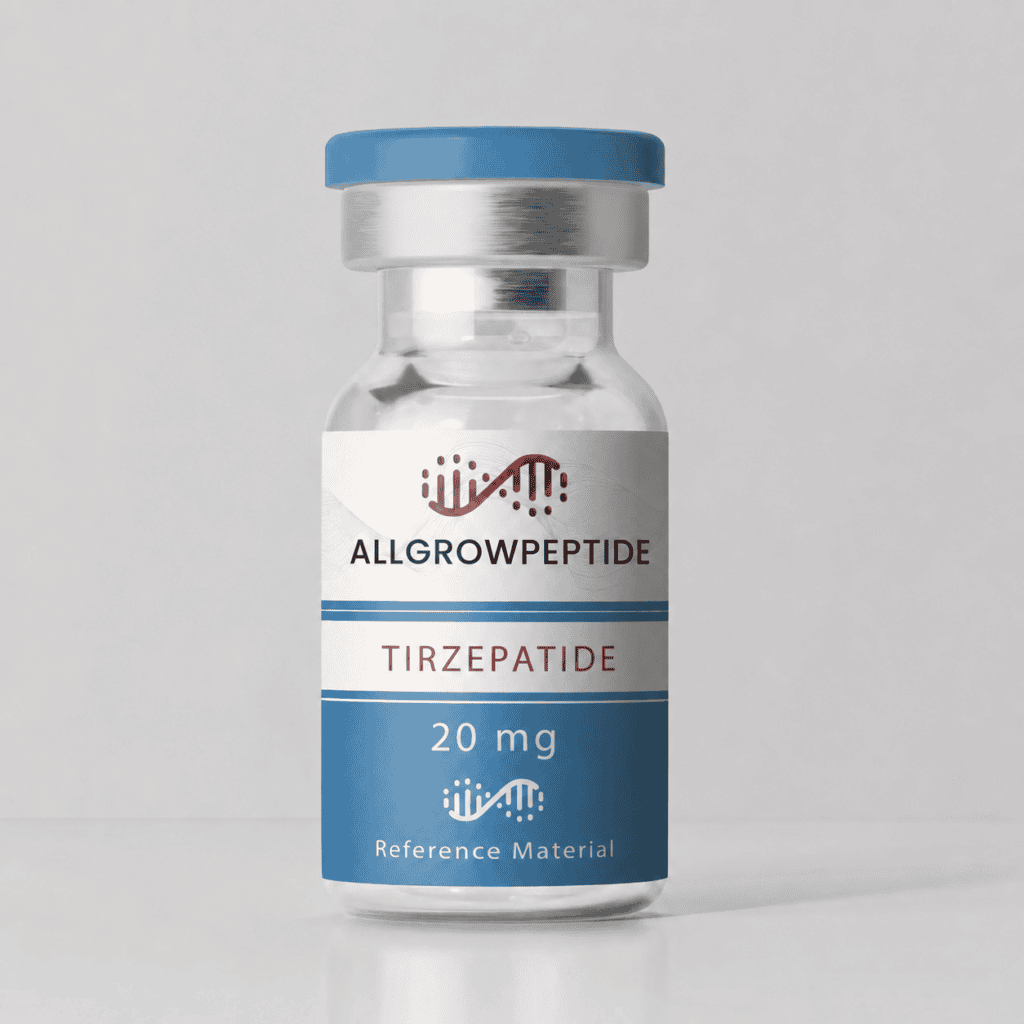
Tirzepatide is a synthetic, long-acting peptide engineered to activate both the glucose-dependent insulinotropic polypeptide receptor, or GIPR, and the glucagon-like peptide-1 receptor, or GLP-1R. Researchers study it because this single molecule links two incretin signaling systems while showing distinct receptor pharmacology.
The peptide contains 39 amino-acid residues and a C20 fatty-diacid modification. That modification promotes albumin binding and extends systemic exposure. As a result, tirzepatide has become an important model for studying receptor co-agonism, biased signaling, metabolic regulation, adipose biology, liver metabolism, kidney outcomes, and cardiometabolic physiology.
This scientific resource reviews its molecular structure, receptor pharmacology, experimental evidence, research concentrations, analytical verification, stability, and emerging research directions.
What Is Tirzepatide?
Tirzepatide
Tirzepatide, originally designated LY3298176, is a synthetic peptide based largely on the human GIP sequence.
The FDA describes the molecule as a GIP receptor and GLP-1 receptor agonist. It contains aminoisobutyric acid, or Aib, at positions 2 and 13. A C20 fatty diacid attaches through a linker at Lys20. The molecule also has a C-terminal amide.
Molecular Characteristics
Peptide length: 39 amino-acid residues
Molecular formula: C225H348N48O68
Molecular weight: approximately 4,813.53 Da
CAS number: 2023788-19-2
Structure: linear, acylated synthetic peptide
Parent sequence: primarily GIP-derived
Modified residues: Aib at positions 2 and 13
Lipid modification: C20 fatty diacid linked through Lys20
The Lys20 side chain carries the linker and C20 fatty-diacid group.
Chemical Structure
Tirzepatide does not contain cysteine residues. Therefore, conventional intramolecular disulfide bonds are not part of its structure.
The peptide instead depends on its linear amino-acid sequence, engineered substitutions, terminal amidation, and lipid conjugation.
Two structural changes are especially important.
First, Aib residues improve resistance to rapid enzymatic degradation. Second, the fatty-diacid modification strongly promotes reversible albumin association. This slows clearance and contributes to prolonged exposure.
No established functional metal-binding motif forms part of tirzepatide’s recognized pharmacology.
As with other incretin peptides, receptor engagement involves an α-helical peptide conformation within class B G-protein-coupled receptor complexes. However, researchers should not treat tirzepatide as having one rigid solution structure under every experimental condition.
Discovery and Research History
Tirzepatide developed from efforts to combine GIP and GLP-1 receptor pharmacology in one molecule.
Research timeline
2018: Coskun and colleagues described LY3298176 and reported dual GIPR/GLP-1R activity in cellular, animal, and early clinical experiments.
2020: Willard and colleagues characterized its receptor imbalance and GLP-1R signaling bias.
2021: Large SURPASS phase 3 studies reported extensive metabolic data in type 2 diabetes.
May 2022: the FDA initially approved Mounjaro containing tirzepatide.
2022: SURMOUNT-1 expanded research into obesity biology.
November 2023: the FDA approved tirzepatide under the Zepbound name for chronic weight management in specified populations.
2024: studies reported findings in MASH, obstructive sleep apnea, and obesity-related HFpEF.
December 2024: the FDA approved Zepbound for moderate-to-severe obstructive sleep apnea in adults with obesity.
2025: SURPASS-CVOT directly compared cardiovascular outcomes with dulaglutide.
This history shows how tirzepatide research progressed from receptor pharmacology to large translational outcome studies.
Molecular Mechanism of Tirzepatide
Receptor Interaction
Tirzepatide activates two class B GPCRs:
GIP receptor, or GIPR
GLP-1 receptor, or GLP-1R
However, it is not simply a perfectly balanced 50:50 agonist.
Coskun and colleagues reported cAMP EC50 values of approximately 0.0224 nM at GIPR and 0.934 nM at GLP-1R in recombinant receptor systems. Under those assay conditions, its GIPR potency resembled native GIP. Its GLP-1R potency was lower than native GLP-1.
Different receptor-expression and assay systems produce different numerical EC50 values. Therefore, these values should not be treated as universal constants.
Signal Transduction
Both GIPR and GLP-1R primarily couple to Gαs.
Activation increases intracellular cyclic AMP. Downstream signaling can involve:
protein kinase A
EPAC proteins
ion-channel regulation
calcium-dependent secretory pathways
transcriptional responses downstream of cAMP signaling
Importantly, tirzepatide also shows biased signaling at GLP-1R.
Willard and colleagues found that tirzepatide favored cAMP signaling relative to β-arrestin recruitment. The peptide also produced weaker GLP-1R internalization than native GLP-1.
In GTPγS assays, tirzepatide produced full GIPR agonism with an EC50 near 0.379 nM. At GLP-1R, it behaved as a partial agonist in that particular assay.
These differences illustrate why receptor pharmacology should be interpreted in the context of the assay platform.
Cellular Response
Pancreatic β-cell experiments provide one mechanistic model.
GIPR and GLP-1R activation raises cAMP when glucose conditions permit insulin secretion. Tirzepatide can therefore amplify glucose-dependent secretory signaling.
The FDA pharmacology review also reports increased first- and second-phase insulin secretion and reduced glucagon concentrations.
Gene Expression
Tirzepatide does not yet have a universally validated “gene-expression signature.”
Published mechanistic work focuses much more strongly on receptor binding, cAMP generation, β-arrestin signaling, receptor trafficking, islet physiology, and systemic biomarkers.
Consequently, claims that tirzepatide consistently upregulates or downregulates specific large gene sets across tissues would currently overstate the evidence.
Transcriptomic experiments remain a useful future research area. However, tissue, metabolic state, exposure time, receptor abundance, and species can all influence those results.
Historical Tirzepatide Research
Early Research
The 2018 LY3298176 program combined several experimental systems.
Researchers used:
recombinant receptor cell lines
pancreatic β-cell models
differentiated adipocytes
rodent metabolic models
early human pharmacology studies
These experiments established dual receptor activity and provided early evidence that GIPR and GLP-1R activation could coexist within one engineered peptide.
Modern Research
Research later expanded into:
glucose homeostasis
insulin sensitivity
appetite regulation
adipose-tissue physiology
liver fat
kidney function
cardiovascular outcomes
sleep-disordered breathing
heart failure
MASH histology
The evidence is therefore unusually broad for a synthetic peptide.
However, these research areas do not all have equal mechanistic certainty. Clinical outcome associations should not automatically be interpreted as direct cellular effects on every affected organ.
Glucose Regulation and Pancreatic Biology Research
Tirzepatide research initially focused heavily on glucose-dependent endocrine signaling.
The FDA reports that tirzepatide increases first- and second-phase insulin secretion. It also decreases fasting and postprandial glucagon concentrations.
In a pharmacodynamic study, 15 mg reduced fasting glucagon by about 28% and post-meal glucagon exposure by approximately 43% after 28 weeks compared with little change under placebo conditions.
SURPASS trials later quantified systemic effects.
In SURPASS-2, tirzepatide produced greater HbA1c reductions than once-weekly semaglutide 1 mg after 40 weeks. The trial also observed greater mean body-weight reductions across tirzepatide groups.
Biological Significance
These results support several research hypotheses:
simultaneous GIPR and GLP-1R activation can enhance glucose-dependent insulin signaling;
GIPR activity may complement GLP-1R pharmacology;
receptor bias may modify downstream signaling efficiency;
improved insulin sensitivity may contribute alongside direct β-cell effects.
However, the relative contribution of each receptor remains an active mechanistic question.
Adipose Tissue, Appetite, and Energy-Balance Research
Tirzepatide also alters whole-body energy balance.
In SURMOUNT-1, 2,539 participants without diabetes entered a 72-week randomized study.
Mean body-weight changes were:
−15.0% with 5 mg
−19.5% with 10 mg
−20.9% with 15 mg
−3.1% with placebo
Moreover, 57% of participants receiving 15 mg achieved at least 20% weight reduction.
These are human clinical observations. They should not be interpreted as equivalent outcomes in cell or animal experiments.
Proposed Mechanisms
Current models include:
altered hypothalamic appetite signaling
delayed gastric emptying, strongest after early exposures
reduced energy intake
improved insulin sensitivity
altered adipose-tissue metabolic signaling
The FDA notes that the gastric-emptying delay is strongest after the initial dose and decreases with repeated exposure.
Liver and Adipose Distribution Research
MRI-based studies provide quantitative evidence beyond body weight.
The SURPASS-3 MRI substudy included 296 participants. Mean baseline liver fat content was about 15.71%.
At week 52, pooled tirzepatide 10 mg and 15 mg groups showed an absolute liver-fat reduction of 8.09 percentage points. Insulin degludec produced a reduction of 3.38 percentage points.
The estimated between-group difference was −4.71 percentage points.
Researchers also observed reductions in visceral and abdominal subcutaneous adipose tissue.
These data support further study of hepatic lipid metabolism. They do not prove that every liver effect results from direct hepatic receptor signaling.
MASH Research
The SYNERGY-NASH trial extended liver research to biopsy-defined disease.
The phase 2 study included 190 participants with MASH and stage F2 or F3 fibrosis.
After 52 weeks, MASH resolution without worsening fibrosis occurred in:
10% with placebo
44% with tirzepatide 5 mg
56% with tirzepatide 10 mg
62% with tirzepatide 15 mg
Improvement of at least one fibrosis stage without worsening MASH occurred in 30% of placebo participants and 51–55% of tirzepatide participants.
These results are clinically important research findings. However, the trial was phase 2 and relatively limited in size.
Longer studies remain necessary to determine durability and long-term liver outcomes.
Kidney Research
Kidney outcomes represent another active research field.
A post-hoc SURPASS-4 analysis compared tirzepatide with insulin glargine.
Mean annual eGFR decline was:
−1.4 mL/min/1.73 m²/year with pooled tirzepatide
−3.6 mL/min/1.73 m²/year with insulin glargine
The between-group difference was 2.2 mL/min/1.73 m²/year.
The kidney composite outcome produced a hazard ratio of 0.58 for tirzepatide versus insulin glargine.
These were secondary or post-hoc analyses. Therefore, they should generate and strengthen hypotheses rather than be interpreted identically to a kidney-specific primary-outcome trial.
Sleep and Respiratory Research
SURMOUNT-OSA studied adults with obesity and moderate-to-severe obstructive sleep apnea.
Two phase 3 trials followed participants for 52 weeks.
In the trial without baseline PAP use, mean apnea-hypopnea index change was:
−25.3 events/hour with tirzepatide
−5.3 events/hour with placebo
In the PAP-treated trial, corresponding changes were:
−29.3 events/hour
−5.5 events/hour
Both comparisons favored tirzepatide.
The FDA subsequently approved tirzepatide for a defined OSA population in December 2024.
For laboratory researchers, these results raise questions about how adiposity, inflammation, respiratory mechanics, and metabolic signaling interact.
Cardiovascular and Heart-Failure Research
Cardiovascular research has advanced rapidly.
The SUMMIT trial studied participants with obesity and heart failure with preserved ejection fraction.
Cardiovascular death or worsening heart failure occurred in:
9.9% of the tirzepatide group
15.3% of the placebo group
The reported hazard ratio was 0.62.
Health-status scores also improved more with tirzepatide.
More recently, SURPASS-CVOT enrolled more than 13,000 participants with type 2 diabetes and established atherosclerotic cardiovascular disease.
The primary cardiovascular endpoint occurred in:
12.2% with tirzepatide
13.1% with dulaglutide
The hazard ratio was 0.92 with a 95.3% confidence interval of 0.83–1.01.
Tirzepatide met the trial’s noninferiority criterion. It did not meet the prespecified superiority threshold for the primary endpoint.
That distinction is scientifically important.
Key Quantitative Research Findings
Research Area
Study
Model / Sample
Key Quantitative Finding
Receptor signaling
Coskun et al.
Recombinant cellular assays
cAMP EC50: ~0.0224 nM at GIPR and ~0.934 nM at GLP-1R
Body weight
SURMOUNT-1
2,539 adults
Mean change at 72 weeks: −15.0%, −19.5%, and −20.9% for 5, 10, and 15 mg
Liver fat
SURPASS-3 MRI
296 participants
Pooled 10/15 mg groups: −8.09 percentage-point liver-fat change at week 52
Kidney outcomes
SURPASS-4 analysis
1,995 treated participants
eGFR slope −1.4 vs −3.6 mL/min/1.73 m²/year versus insulin glargine
MASH histology
SYNERGY-NASH
190 participants
MASH resolution without worsening fibrosis: 44–62% vs 10% placebo
Obstructive sleep apnea
SURMOUNT-OSA
Two phase 3 trials
AHI treatment differences approximately −20.0 and −23.8 events/hour
Cardiovascular outcomes
SURPASS-CVOT
13,165 modified ITT participants
MACE-3 HR 0.92 vs dulaglutide; noninferiority achieved
Beyond this framework, the literature becomes more model-dependent.
Established Findings
GIPR activation
GLP-1R activation
cAMP generation
modulation of β-arrestin recruitment
altered receptor internalization
glucose-dependent insulin secretion
modulation of glucagon secretion
Emerging Questions
Researchers continue to investigate:
tissue-specific transcriptional responses
mitochondrial adaptation
adipocyte differentiation and lipid handling
inflammatory signaling
hepatocyte and stellate-cell responses
central nervous system pathway changes
At present, no short list of “tirzepatide genes” should be presented as universally established.
Concentrations Used in Research
In Vitro Research
There is no universal tirzepatide concentration suitable for every assay.
Published receptor experiments illustrate why.
Coskun et al. reported cAMP EC50 values near:
0.0224 nM — GIPR
0.934 nM — GLP-1R
Willard et al. obtained different potency estimates using other signaling endpoints. For example, GTPγS assays produced values near 0.379 nM at GIPR and 0.617 nM at GLP-1R.
Therefore, research concentrations should reflect:
receptor density
assay endpoint
incubation duration
albumin concentration
cell type
expected receptor occupancy
peptide adsorption to experimental surfaces
Albumin is especially important. Tirzepatide binds albumin strongly, so free peptide exposure can differ substantially between assay matrices.
Animal Research
Preclinical studies have used multiple rodent models and exposure schedules.
A single “standard animal dose” does not exist.
Researchers should report the original dose, route, species, treatment duration, formulation, and sampling conditions from each publication.
Animal exposures should not be converted directly into human dosing recommendations.
Tirzepatide 10mg and Tirzepatide 20mg Labels
In research catalog contexts, terms such as tirzepatide 10mg or tirzepatide 20mg may describe nominal material quantity.
They do not establish:
concentration
biological activity
purity
formulation
sterility
approved dosage
clinical equivalence
A 20 mg research-vial label should therefore never be interpreted as evidence for a 20 mg human dosing regimen.
Safety Profile in Research
Preclinical Safety
Tirzepatide has undergone extensive pharmacology and toxicology testing.
One important finding involves thyroid C-cell tumors in rats. The current U.S. prescribing information retains a boxed warning based on those animal findings. The relevance of the rodent observation to humans remains uncertain.
This is an example of why animal toxicology and human risk cannot be treated as identical.
Human Research Safety
Across trials, the most frequently reported adverse events have involved the gastrointestinal system.
Examples include:
nausea
diarrhea
vomiting
constipation
abdominal symptoms
decreased appetite
In SURPASS-2, nausea occurred in approximately 17–22% of tirzepatide participants. Diarrhea occurred in about 13–16%.
The FDA also lists pancreatitis, gallbladder disease, hypersensitivity, and other clinically relevant warnings.
Hypoglycemia risk depends strongly on experimental or clinical context. In human studies, risk increased when tirzepatide was combined with insulin or insulin secretagogues.
Long-term data remain limited for several emerging research indications.
Safety findings from approved pharmaceutical formulations should also not be assumed to apply automatically to unverified research materials.
Tirzepatide Research Applications
Cellular Research
Researchers can use tirzepatide to investigate:
GIPR pharmacology
GLP-1R pharmacology
cAMP signaling
receptor internalization
β-arrestin recruitment
pancreatic β-cell signaling
Molecular Biology
Relevant research questions include:
receptor bias
GPCR trafficking
receptor occupancy
signaling kinetics
downstream phosphorylation
transcriptomic responses
Tissue Research
Tissue-level research can examine:
pancreatic islets
adipose tissue
liver
gastrointestinal tissue
cardiovascular tissue
central metabolic pathways
Translational Research
Tirzepatide also offers a model for studying how molecular receptor pharmacology translates into systemic physiology.
That relationship is especially valuable because large clinical datasets now exist alongside detailed receptor-level experiments.
Research Quality Requirements
Research reproducibility depends on more than the stated peptide name.
Purity Standards
HPLC remains useful for assessing chromatographic purity.
However, a label such as ≥98% HPLC purity is a supplier or batch specification. It is not an inherent property of tirzepatide.
Furthermore, chromatographic area percentage alone does not prove correct molecular identity.
FDA peptide-quality research has shown that peptide APIs can contain deletion products, insertion products, oxidation products, deamidation products, and other related impurities. Some may require high-resolution mass spectrometry for adequate characterization.
Identity Verification
A stronger analytical package may include:
LC-MS
high-resolution MS
intact molecular-mass confirmation
HPLC or UHPLC chromatogram
peptide-content assay
sequence-related characterization when appropriate
The expected molecular mass should be consistent with approximately 4813.53 Da for tirzepatide itself.
Analytical Documentation
For research procurement, useful batch documentation can include:
batch-specific Certificate of Analysis
lot number
HPLC chromatogram
mass spectrum
measured purity
measured peptide content
manufacturing or testing date
retest or expiry information
storage specification
Additional Testing
The appropriate additional tests depend on material type and intended experiment.
Possible tests include:
water content
residual solvents
counter-ion analysis
elemental impurities
peptide-related impurities
endotoxin for relevant biological assays
microbial testing when required
aggregation analysis
Not every test is necessary for every research application.
The testing strategy should match the scientific risk.
Storage and Stability
Storage recommendations require careful distinction between approved pharmaceutical formulations and research peptide materials.
Approved Tirzepatide Solution
The current FDA Mounjaro labeling specifies refrigerated storage at 2°C to 8°C.
It also permits specified single-dose products to remain below 30°C for up to 21 days. The product should not be frozen and should remain protected from light.
These data apply to that validated pharmaceutical formulation.
They should not automatically be copied to an unrelated lyophilized research material.
Lyophilized Peptide
Research-grade lyophilized tirzepatide may have different validated conditions.
Relevant stability factors include:
temperature
residual moisture
oxygen exposure
container closure
light
peptide purity
counter-ion
formulation excipients
Therefore:
Storage recommendations may vary by formulation and supplier specification.
Peptide in Solution
Solutions can be more vulnerable to:
oxidation
hydrolysis
deamidation
aggregation
surface adsorption
microbial contamination
Repeated freeze-thaw cycles should be evaluated rather than assumed harmless.
For reproducible experiments, laboratories should follow batch-specific stability data whenever available.
Future Tirzepatide Research Directions
Receptor-Specific Mechanistic Research
One central question remains unresolved:
How much of tirzepatide’s biology results from GIPR activation versus GLP-1R activation?
Selective receptor antagonism, genetic models, tissue-specific receptor deletion, and advanced imaging may help answer this.
Biased Signaling
GLP-1R signaling bias deserves continued study.
Important endpoints include:
cAMP kinetics
β-arrestin recruitment
receptor internalization
recycling
desensitization
downstream transcription
Tissue-Specific Research
Researchers increasingly need to separate direct receptor effects from secondary effects caused by altered body weight, glucose, insulin, or inflammation.
This is especially relevant for:
kidney
liver
cardiovascular tissue
adipose tissue
brain
Biomarker Research
Future work may identify biomarkers that predict:
receptor responsiveness
metabolic response
hepatic response
kidney response
cardiovascular response
Combination and Multi-Agonist Research
Tirzepatide has also influenced development of next-generation multi-receptor molecules.
Research now includes GLP-1/GIP/glucagon triple agonists and other multi-pathway peptides.
Tirzepatide therefore serves as both a research compound and a proof-of-concept for unimolecular polypharmacology.
Research-Grade Tirzepatide Quality
For controlled laboratory work, documentation should take priority over marketing terminology.
Independent Verification
Where possible, identity and purity data should come from validated analytical methods.
Batch Documentation
A useful research batch record should connect:
lot number → chromatogram → mass spectrum → specification → storage information
This improves traceability and experimental reproducibility.
Manufacturing Consistency
Consistency across batches matters because small changes in:
sequence-related impurities
oxidation
water content
peptide content
aggregation
residual reagents
can alter biological assays.
AllGrowPeptide provides research-focused documentation for qualified peptide materials, subject to batch availability and product specification.
Terms such as “research grade” should never substitute for actual analytical evidence.
Conclusion
Tirzepatide is a 39-residue synthetic peptide that combines GIPR and GLP-1R agonism within one long-acting molecular design. Its C20 fatty-diacid modification promotes albumin binding, while Aib substitutions improve metabolic stability. Together, these structural features support prolonged exposure.
At the molecular level, research shows strong GIPR activity alongside GLP-1R activation. Importantly, tirzepatide displays signaling behavior that differs from native GLP-1, including reduced β-arrestin recruitment and altered receptor trafficking.
The research literature now extends far beyond glucose control. Studies have examined adipose physiology, liver fat, kidney outcomes, MASH histology, obstructive sleep apnea, HFpEF, and cardiovascular outcomes. Still, clinical associations should not automatically be interpreted as direct molecular actions within every organ.
For laboratory studies, experimental context matters. Receptor expression, assay design, albumin concentration, material quality, and peptide stability can all change observed potency.
Future research will likely focus on tissue-specific receptor biology, signaling bias, molecular biomarkers, multi-agonist design, and mechanisms that separate direct receptor action from secondary metabolic changes.
Research Highlights
Tirzepatide contains 39 amino-acid residues.
Molecular weight is approximately 4813.53 Da.
It activates both GIPR and GLP-1R.
Published cAMP assays report EC50 values near 0.0224 nM at GIPR and 0.934 nM at GLP-1R.
The molecule shows GLP-1R signaling bias relative to native GLP-1.
Its C20 fatty diacid supports approximately 99% albumin binding.
Reported elimination half-life is approximately 5 days.
Research now spans metabolic, hepatic, renal, respiratory, and cardiovascular biology.
HPLC purity alone does not establish peptide identity or complete impurity control.
Research concentrations and storage conditions should remain assay- and formulation-specific.
Research Use Only
Research Use Only: Any research-grade tirzepatide material discussed in the procurement and analytical sections of this page is intended for controlled laboratory research and scientific investigation only. It is not presented as a medicine, treatment, diagnostic product, or recommendation for human or veterinary use. FDA-approved prescription products containing tirzepatide are separate regulated pharmaceutical formulations and should not be considered equivalent to unapproved research materials.
References
Coskun T, Sloop KW, Loghin C, et al. LY3298176, a novel dual GIP and GLP-1 receptor agonist for the treatment of type 2 diabetes mellitus: From discovery to clinical proof of concept. Molecular Metabolism. 2018;18:3-14. doi: 10.1016/j.molmet.2018.09.009. PMID: 30473097.
Willard FS, Douros JD, Gabe MBN, et al. Tirzepatide is an imbalanced and biased dual GIP and GLP-1 receptor agonist. JCI Insight. 2020;5(17):e140532. doi: 10.1172/jci.insight.140532. PMID: 32730231.
Rosenstock J, Wysham C, Frías JP, et al. Efficacy and safety of a novel dual GIP and GLP-1 receptor agonist tirzepatide in patients with type 2 diabetes (SURPASS-1). Lancet. 2021;398:143-155. doi: 10.1016/S0140-6736(21)01324-6. PMID: 34186022.
Frías JP, Davies MJ, Rosenstock J, et al. Tirzepatide versus Semaglutide Once Weekly in Patients with Type 2 Diabetes. N Engl J Med. 2021;385:503-515. doi: 10.1056/NEJMoa2107519. PMID: 34170647.
Ludvik B, Giorgino F, Jódar E, et al. Once-weekly tirzepatide versus once-daily insulin degludec in SURPASS-3. Lancet. 2021;398:583-598. doi: 10.1016/S0140-6736(21)01443-4. PMID: 34370970.
Del Prato S, Kahn SE, Pavo I, et al. Tirzepatide versus insulin glargine in type 2 diabetes and increased cardiovascular risk: SURPASS-4. Lancet. 2021;398:1811-1824. doi: 10.1016/S0140-6736(21)02188-7. PMID: 34672967.
Dahl D, Onishi Y, Norwood P, et al. Effect of Subcutaneous Tirzepatide vs Placebo Added to Titrated Insulin Glargine: SURPASS-5. JAMA. 2022;327:534-545. doi: 10.1001/jama.2022.0078. PMID: 35133415.
Jastreboff AM, Aronne LJ, Ahmad NN, et al. Tirzepatide Once Weekly for the Treatment of Obesity. N Engl J Med. 2022;387:205-216. doi: 10.1056/NEJMoa2206038. PMID: 35658024.
Gastaldelli A, Cusi K, Fernández Landó L, et al. Effect of tirzepatide versus insulin degludec on liver fat content and abdominal adipose tissue: SURPASS-3 MRI. Lancet Diabetes Endocrinol. 2022;10:393-406. doi: 10.1016/S2213-8587(22)00070-5. PMID: 35468325.
Heerspink HJL, Sattar N, Pavo I, et al. Effects of tirzepatide versus insulin glargine on kidney outcomes in SURPASS-4. Lancet Diabetes Endocrinol. 2022;10:774-785. doi: 10.1016/S2213-8587(22)00243-1. PMID: 36152639.
Loomba R, Hartman ML, Lawitz EJ, et al. Tirzepatide for Metabolic Dysfunction-Associated Steatohepatitis with Liver Fibrosis. N Engl J Med. 2024;391:299-310. doi: 10.1056/NEJMoa2401943. PMID: 38856224.
Malhotra A, Grunstein RR, Fietze I, et al. Tirzepatide for the Treatment of Obstructive Sleep Apnea and Obesity. N Engl J Med. 2024;391:1193-1205. doi: 10.1056/NEJMoa2404881. PMID: 38912654.
Packer M, Zile MR, Kramer CM, et al. Tirzepatide for Heart Failure with Preserved Ejection Fraction and Obesity. N Engl J Med. 2025;392:427-437. doi: 10.1056/NEJMoa2410027. PMID: 39555826.
Nicholls SJ, Pavo I, Bhatt DL, et al. Cardiovascular Outcomes with Tirzepatide versus Dulaglutide in Type 2 Diabetes. N Engl J Med. 2025;393:2409-2420. doi: 10.1056/NEJMoa2505928. PMID: 41406444.
U.S. Food and Drug Administration. MOUNJARO (tirzepatide) Prescribing Information. Revised December 2025. Includes molecular description, pharmacodynamics, pharmacokinetics, safety, and storage information.